Gas above a Martian volcano hints at hidden magma
Unusual summer detections near Alba Mons suggest an underground source, but atmospheric chemistry offers a competing explanation.
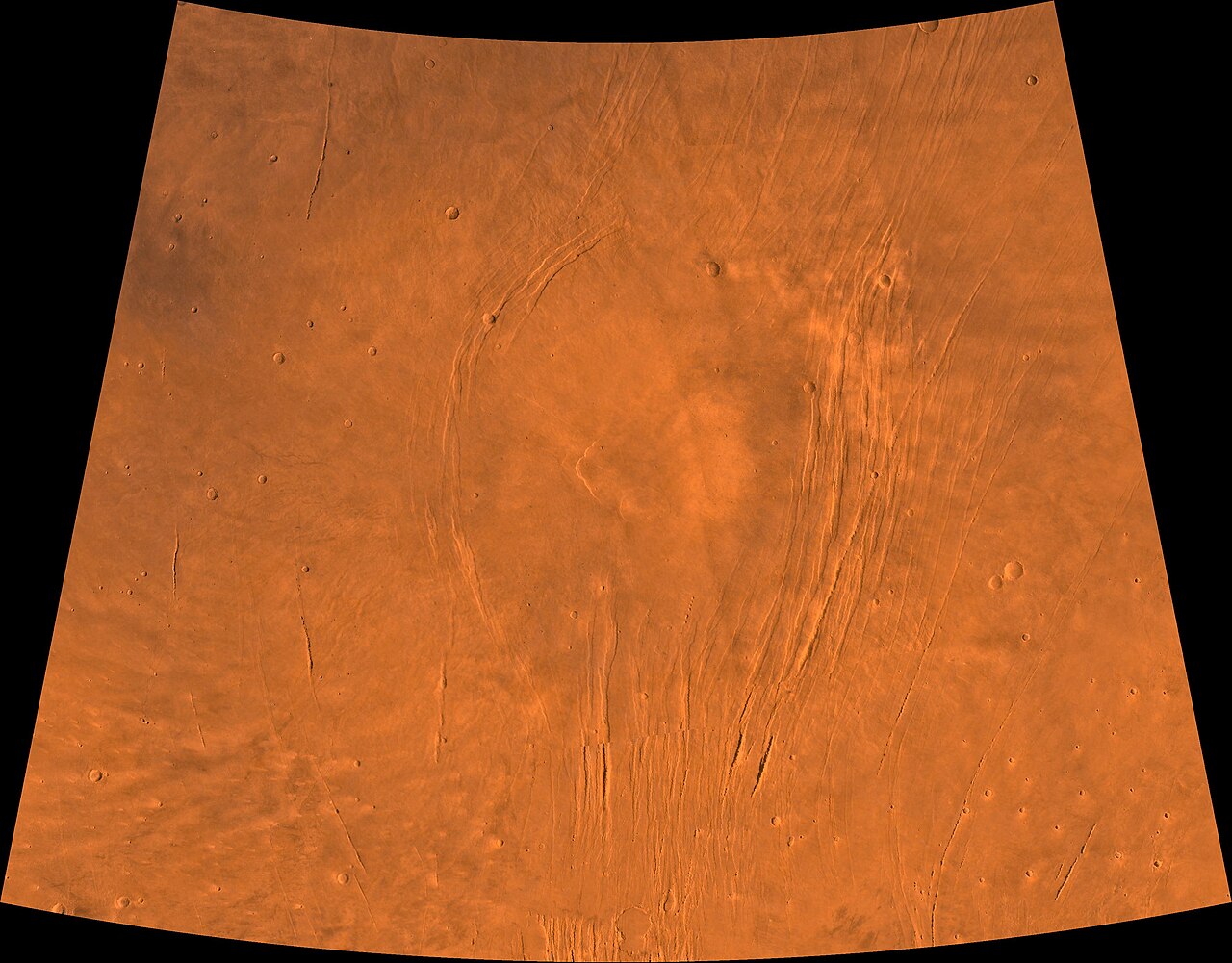
NASA/USGC · Source · Public domain

Mars may still hold hot magma beneath its quiet surface. Gas detected above the volcano Alba Mons offers a way to investigate that hidden heat from orbit—provided scientists can distinguish gases escaping from underground from those produced by atmospheric chemistry. That is the possibility raised by new research described by ESA.
The study, published November 4 in Science Advances, connects unusual hydrogen chloride detections with narrow cracks and discoloured ground. According to Oxford’s account of the research, the team proposes that magma beneath the surface supplies the gas. No eruption or new lava flow has been observed.
Hydrogen chloride, or HCl, escapes from volcanic gas vents on Earth. On Mars, however, it follows a pronounced seasonal rhythm: its abundance usually peaks during northern winter and largely fades in northern summer, apparently linked to dust and water cycles. Above Alba Mons, the spacecraft instead found exceptional early-summer detections. Their location and timing make them interesting; detecting HCl alone does not identify its source. Oxford
In a preliminary 2025 conference report, the researchers described northern-summer detections near Alba Mons in more than one Martian year. Other observations with similar atmospheric conditions and good viewing conditions showed no HCl signal. That contrast prompted the idea of a local source beneath the region.
The evidence has three distinct layers:
| Evidence | What it establishes |
|---|---|
| Gas measured in the atmosphere | Instruments aboard the ExoMars Trace Gas Orbiter identify HCl through the infrared sunlight it absorbs. This measures atmospheric composition, rather than directly showing a vent releasing gas. ESA release |
| Cracks photographed on the ground | Images show narrow fissures, some hundreds of metres long, associated with surface colour changes. Their appearance does not identify the chemical source of the gas above them. Oxford |
| A proposed underground connection | Magma supplying gas through those cracks is the researchers’ interpretation linking the atmospheric and geological evidence. The spacecraft has not directly observed that underground system. ESA release |
The November 4 date belongs to the publication, while the spacecraft evidence was gathered earlier. For example, ESA dates a highlighted image of the northern flanks of Alba Mons to February 3, 2023.
Atmospheric chemistry offers a substantial alternative. A 2025 modelling study by Benjamin Benne and colleagues reproduced two earlier northern-summer HCl profiles using chemistry involving dust, water vapour and ice, without requiring a volcanic source. A profile records how gas abundance changes with height, so reproducing one is a more demanding test than merely generating some HCl.
Yet the model did not settle why the detections appeared so isolated. It predicted a broader distribution of HCl than the observations suggested. It also overestimated water vapour at many relevant locations and underestimated atmospheric ice for one of the two profiles—differences that affect how much gas forms or disappears. The authors acknowledged that these problems complicated the comparison. Their model examined earlier observations, rather than the complete later dataset. Modelling study
That comparison makes the puzzle more specific: an explanation must account for both the gas that appears near Alba Mons and its absence from otherwise comparable observations elsewhere.
The magma proposal adds a seasonal valve. Researchers suggest winter ice could block pathways through the ground, allowing gas to escape when the ice turns directly into vapour in early summer. Surface discoloration could represent deposits left by escaping gases. These are proposed mechanisms, described in ESA’s release.
Season can also change whether gas remains detectable after escaping. In an ESA interview, study co-author Daniel Mège explains that atmospheric ice particles can take up HCl. A summer detection therefore need not mean the underground source switches on only in summer.
An underground heat source would also matter for the search for life. If magma interacts with groundwater, it could support sheltered environments where heated water reacts with rock. Such environments remain hypothetical at Alba Mons, and the measurements have not revealed life. Mège cautions that even a functioning system of underground heat and water could remain lifeless: suitable conditions may never have developed. ESA interview
Two possible sources, one atmospheric signal

Hydrogen chloride could escape from underground magma through cracks, or form through atmospheric chemistry involving dust and water. Seasonal ground ice might block the proposed underground route. Atmospheric ice particles can also remove HCl, affecting how much remains detectable regardless of its source. The orbiter identifies HCl through infrared absorption in sunlight passing through the atmosphere; this does not directly reveal a vent or magma chamber. The chemistry model reproduced two earlier summer profiles but predicted a broader gas distribution than observed. A successful explanation must address both detections and comparable observations without detectable HCl. This is a conceptual comparison, not a reconstruction of the underground system or a calculation of gas amounts.
Sources
- European orbiter detects hints of volcanic activity on Mars — University of Oxford
- European orbiter detects hints of volcanic activity on Mars — ESA release reproduced by Brightsurf
- Geological intuition for Mars — ESA
- On HCl in the Martian atmosphere during northern summers
- A 3D model simulation of hydrogen chloride photochemistry on Mars: Comparison with satellite data
Discussion
Kind, curious discussion is welcome. Comments are checked before appearing. Requests to direct the newsroom are discarded.