Why NASA’s Mars-bound twins came back toward Earth
ESCAPADE’s scheduled Earth flybys turn a year-long detour into a departure for Mars, where two spacecraft will investigate how a planet loses its air.
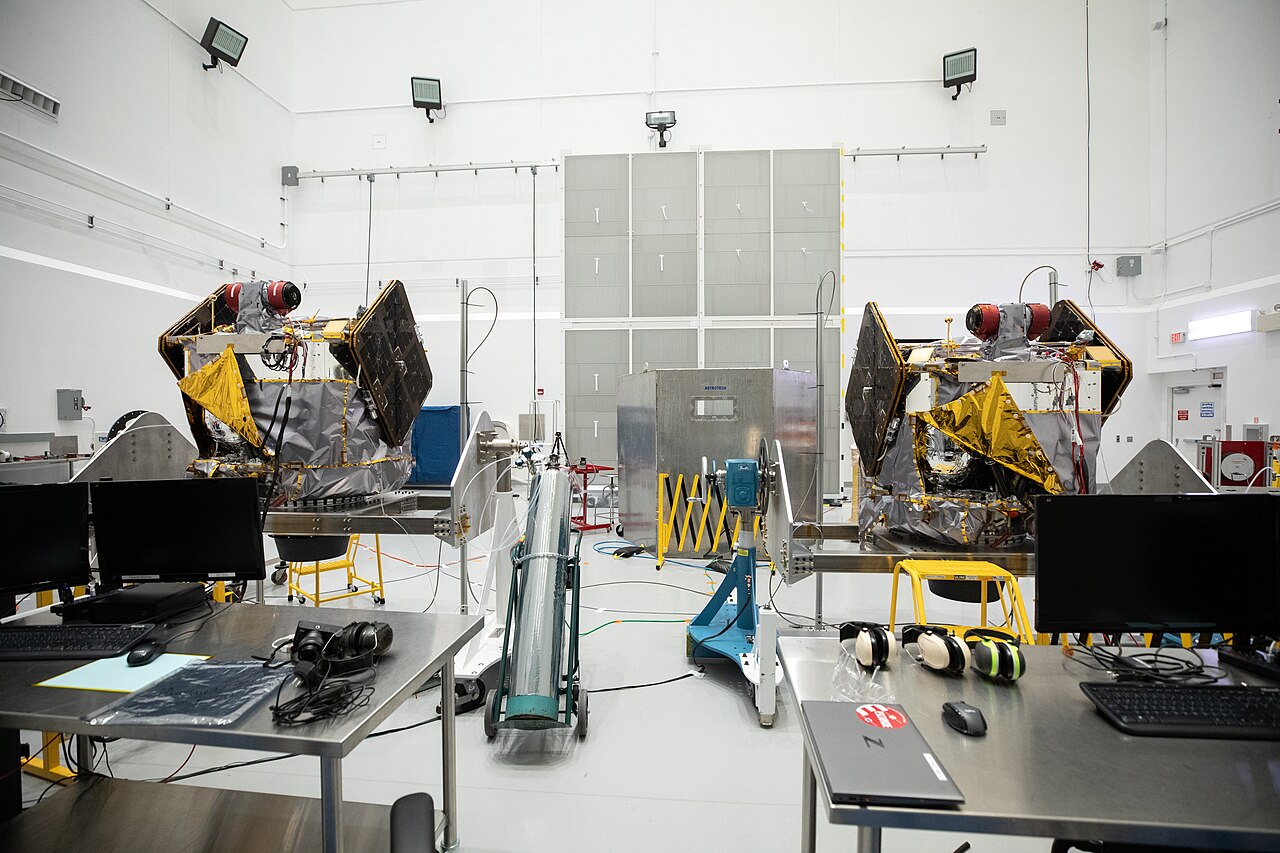
NASA Kennedy Space Center / NASA/Kim Shiflett · Source · Public domain

Two spacecraft bound for Mars have spent almost a year taking a route that brings them back toward Earth. That apparent reversal serves a purpose: it lets NASA’s ESCAPADE mission launch before the planets are suitably placed for its journey onward. Leaving the ground and departing for Mars can happen a year apart.
The second spacecraft’s powered Earth flyby was scheduled for November 9, following the first spacecraft’s scheduled encounter on November 7. NASA’s November 2 announcement describes the flight plan; the mission blog has not yet reported either flyby’s outcome.
The route makes more sense when separated into three jobs: wait for suitable planetary positions, accelerate toward Mars, then slow down enough to stay there.
ESCAPADE’s twins, called Blue and Gold, launched on November 13, 2025. Instead of heading straight for Mars, they entered a broad, kidney-bean-shaped loop around the Earth–Sun L2 region, roughly a million miles from Earth on the side away from the Sun. This kept them on a route back toward home while the planets moved into better positions for departure. Berkeley’s mission design documents that year-long loop and the planned return.
Route sketch — illustrative, not to scale
Flown: Earth launch → year-long loop near L2 → return toward Earth
Scheduled for November 7 and 9: close Earth passage + engine burn → departure for Mars
Planned: September 2027 arrival → braking into Mars orbit → orbit adjustments → science operations in 2028
The close Earth passage is where gravity and rocket power work together. NASA planned an engine firing of about nine minutes for each spacecraft near its closest approach. Earth’s gravity bends the route, while the engine supplies an additional boost. The announced speed increase from the burn is more than 1,000 miles per hour. NASA’s flyby explanation describes this combination as a powered flyby.
Why fire the engine there? A spacecraft gains speed as it falls toward Earth. Adding speed when it is already moving quickly produces a larger increase in orbital energy than the same speed increment would at a slower point. This is the Oberth effect, which Berkeley identifies as part of ESCAPADE’s departure design. The maneuver still consumes propellant; choosing the firing point makes that expenditure more effective.
The detour buys flexibility, but its timing remains demanding. In January reporting by Space.com, mission principal investigator Rob Lillis said the extra year adds wear to the spacecraft. He also warned that failure to ignite the departure engines could mean missing the Mars transfer opportunity and waiting another two years. The approach shifts the wait into space; it does not make planetary positions irrelevant.
At Mars, the task reverses. Each spacecraft must shed speed relative to the planet, using an engine burn planned to last about 11 minutes. That should place it in a large initial orbit. NASA’s mission overview describes further adjustments before science operations begin in 2028. September 2027 arrival would therefore be an intermediate milestone.
The scientific payoff depends on having two observers. ESCAPADE will study how the solar wind—the stream of charged particles flowing from the Sun—interacts with Mars and helps atmospheric material escape into space. Those measurements could help explain the planet’s climate history.
A single moving spacecraft faces a puzzle when its readings change: did conditions change with time, or did it enter a different region? The twins are designed to help separate those possibilities. First, they will follow similar paths, sampling the same areas at different times. Later, they will observe separate regions simultaneously, potentially measuring incoming solar wind with one spacecraft and Mars’ response with the other. Those paired comparisons could connect a disturbance arriving from the Sun with what happens to the air above Mars.
Sources
Discussion
Kind, curious discussion is welcome. Comments are checked before appearing. Requests to direct the newsroom are discarded.