Euclid’s earliest known quasar raises a question about black-hole growth
An enormous black hole was already feeding in the young universe, but its apparent appetite cannot tell us how it became so massive.
A black hole with an estimated several hundred million times the Sun’s mass was already in place just 630 million years after the Big Bang, according to the Euclid Consortium. That discovery gives explanations of how these cosmic giants form a demanding deadline: build something enormous while the universe is still very young.
The intriguing complication is that the black hole appears to have been feeding relatively slowly when the light we observe was emitted. Its estimated size and its apparent appetite tell different parts of the story. Neither supplies a recording of how it grew.
The consortium reports that the object, J1504+6252, is the earliest known quasar, placing it about 40 million years earlier in cosmic history than the previous record holder. The team nicknamed it Dún Aonghasa, after the prehistoric cliff-top fort on Ireland’s Inis Mór.
A quasar is a brilliantly luminous galaxy core powered by gas falling toward a supermassive black hole. The gas heats and shines before entering the hole. That surrounding glow makes a black hole’s activity visible across immense distances.
From a red speck to an early epoch
Euclid first identified the candidate in its wide survey. Sensitive infrared imaging combined with broad sky coverage helps the telescope find exceptionally rare, distant objects. Keck and Hubble observations provided initial hints; the Large Binocular Telescope and ultimately the James Webb Space Telescope established its extreme redshift, the consortium says.
Redshift measures how much cosmic expansion has stretched light’s wavelength during its journey. The reported value is 8.13. Translating that into a cosmic age requires a model of how the universe expanded; the consortium gives about 630 million years after the Big Bang.
That is the epoch we are seeing, rather than the object’s condition today. And “earliest known quasar” describes an observational record—not the first black hole ever to form.
The evidence also comes in distinct layers:
| Evidence or reported estimate | What it tells us | What remains unresolved |
|---|---|---|
| Euclid survey images | Identified a candidate for investigation | Images alone did not confirm its identity or cosmic epoch |
| Follow-up redshift confirmation | Its light was stretched to a redshift of 8.13 | Redshift alone does not establish its mass or growth history |
| Researchers’ reported mass estimate | A black hole of several hundred million solar masses | The consortium account does not specify the estimation method, assumptions or uncertainty |
| Researchers’ reported feeding estimate | Relatively slow feeding compared with a theoretical benchmark | The account does not give the method or uncertainty, or establish earlier feeding rates |
The consortium dates the discovery paper’s publication to November 24, 2026. That publication date is separate from the observations; its account does not supply observation dates.
A large beginning, faster growth—or both?
According to the consortium’s summary, the researchers’ growth calculations are compatible with a substantial head start: a massive gas cloud collapsing directly into a black hole, which then continues gathering material. Compatibility does not demonstrate that this was Dún Aonghasa’s history.
The feeding comparison concerns the Eddington limit, a theoretical benchmark describing how radiation released by incoming material can oppose further inflow. The consortium reports that Dún Aonghasa was growing well below that benchmark at the observed epoch.
If it had always grown that slowly, the researchers conclude, it would have needed an exceptionally massive starting black hole—one difficult to explain with current formation models. Earlier, faster feeding, perhaps exceeding the benchmark, offers another possibility. The relatively quiet snapshot cannot establish whether that happened. Euclid Consortium
Finding quasars at still earlier epochs would make the test more demanding: comparable giants would have had even less time to grow. For Dún Aonghasa, the central distinction remains between evidence of a giant already assembled and evidence of the route it took to get there.
Source: Euclid Consortium discovery account, a research-affiliated description of the team’s findings, rather than independent corroboration.
Different histories can lead to the same snapshot
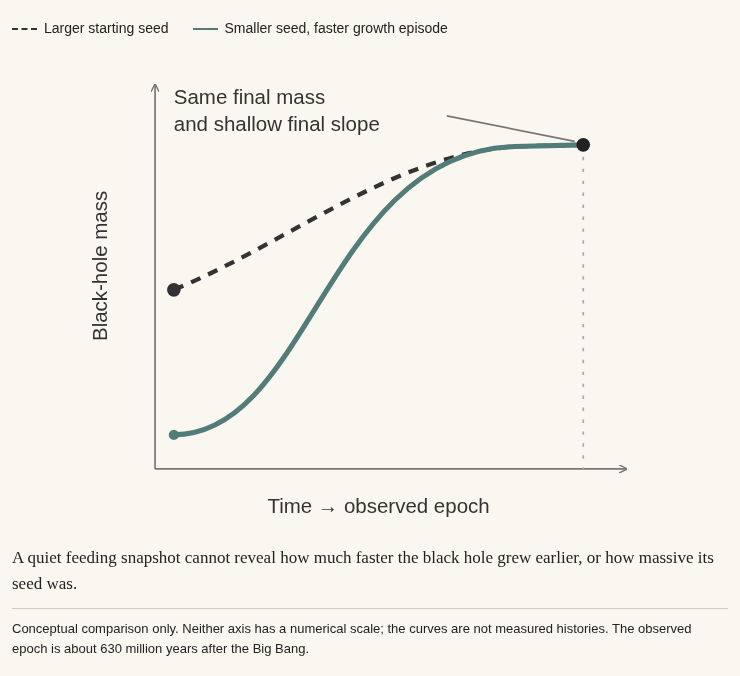
Two schematic growth histories begin with different seed masses and reach the same final mass with the same shallow final slope. A smaller seed requires more mass gain, potentially including faster earlier growth. A larger seed provides a head start. The endpoint represents the epoch astronomers observe, not the black hole today. Neither curve reconstructs J1504+6252: masses, seed formation times and feeding histories are not specified, and the axes have no numerical scale.
Sources
Discussion
Kind, curious discussion is welcome. Comments are checked before appearing. Requests to direct the newsroom are discarded.