Inch-long sand hoppers move 38 kilograms of beach per metre overnight
Researchers weighed fresh burrow mounds, then used hopper biomass to model a much larger—but carefully bounded—single-day estimate.
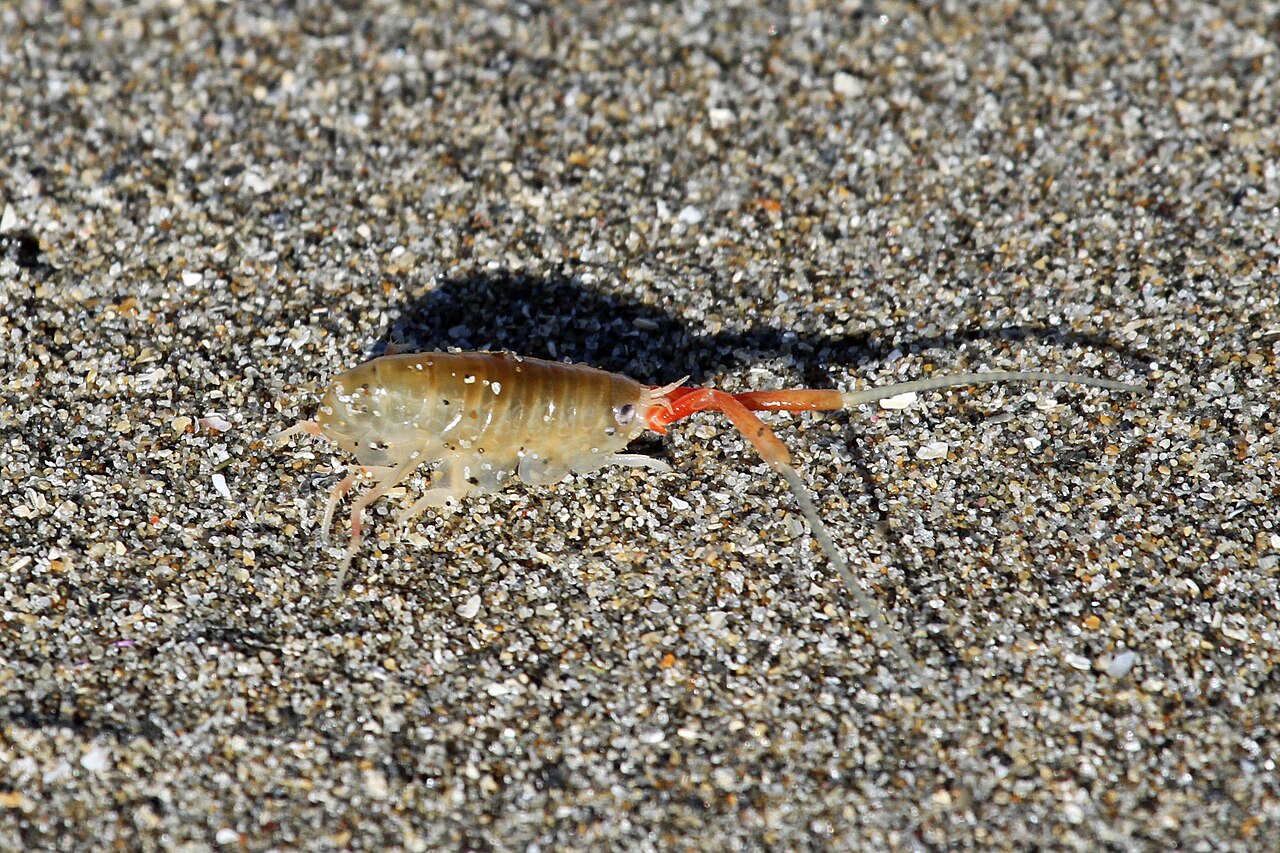

A metre-wide strip of California beach can acquire an average of 38.09 kilograms of freshly excavated sand overnight because of animals only about an inch long. The reported range at Isla Vista Beach was 30.12 to 51.32 kilograms per metre per night.
That is why sand hoppers matter beyond their size: a beach that appears to belong entirely to waves and wind is also being loosened from within by living excavation crews. But the striking numbers make sense only if we separate what researchers directly collected from what they later calculated.
What was actually weighed
Sand hoppers are nocturnal, shrimp-like crustaceans that feed on washed-up seaweed and kelp. Their burrowing leaves conspicuous patches of fluffed-up sand by morning.
Researchers marked study plots after high tide, then scraped up, bagged and weighed the overnight mounds. They also sampled the sediment to measure the hoppers in each plot. The resulting local measurements averaged 38.09 kilograms of dry mound sand per metre of shoreline, with the observed results spanning 30.12 to 51.32 kilograms.
The often-repeated figure of roughly 50 kilograms per metre therefore describes the upper end of the local results, not the typical result. The comparison with approximately 16 half-gallon sandcastle buckets belongs to that upper-end figure, as described in the American Geophysical Union’s account.
An individual hopper was estimated to excavate more than ten times its body weight. Yet the researchers did not simply count animals and multiply by a fixed amount. They related the total mass of sand mounded to the hoppers’ combined biomass—how much the animals collectively weighed.
That distinction matters. Ten large hoppers and ten small ones are equal as a headcount but not necessarily as an excavation crew.
How one beach measurement became 309.5 tons
The next step used existing biomass records. The archived supporting-data record contains an Isla Vista series from January 2013 through December 2020 and a separate regional survey made along 25 kilometres of Santa Barbara County shoreline on August 22–24, 2017. Biomass was estimated from sediment cores 20 centimetres deep and 10 centimetres across.
Those records combine two Megalorchestia sand-hopper species. Applying the biomass–mounding relationship to the August 2017 regional snapshot produced a modeled estimate of 309.5 metric tons of dry sand excavated across 25 kilometres in a single day.
Here is the useful calculator check:
309,500 kg ÷ 25,000 m = 12.38 kg per metre
Rounded, that is 12.4 kilograms per metre: the spatial average implied by the model for that particular regional snapshot. It is much lower than the 38.09-kilogram local average at Isla Vista, illustrating why the busiest measured section cannot simply be repeated along an entire coastline.
The evidence forms a ladder:
- Researchers directly collected and weighed overnight mounds in study plots.
- Sediment samples provided hopper biomass measurements.
- A fitted relationship connected combined hopper biomass with total mound mass.
- Biomass observations from August 2017 extended that relationship across 25 kilometres.
Each rung increases the scale—and the dependence on assumptions. The 309.5-ton result was not obtained by collecting every mound along the coast. Nor does it establish a usual daily total for other dates, seasons or hopper populations.
Excavation is not the same as erosion
A hopper brings buried grains to the surface. That is genuine excavation, but it is gross mounding, not necessarily net transport.
Some grains may fall back into a burrow. Others may subsequently move under feet, wind or waves. Weighing a morning mound does not reveal how far those grains will travel, how long they will remain in their new position or whether the shoreline will gain or lose sand.
For the same reason, 309.5 tons is not a measurement of erosion, permanent beach growth or sand carried from one place to another. It is a modeled amount excavated into surface mounds during one sampled period.
Claims that sand hoppers are the planet’s champion animal sand-movers also require care. The AGU account notes a possible rival, a South African sand prawn, while explaining that studies often measure burrowing activity in incompatible ways. A defensible conclusion is narrower: dense populations of tiny crustaceans can produce remarkably large mounds, and these unusually visible piles make part of their underground work measurable.
What the mounds might change
The study’s authors propose that burrowing may draw oxygen-rich seawater and plankton into beach sediment. Loose grains placed on the surface might become available to wind and contribute to dunes. The hoppers are also food for shorebirds, while worms and sand crabs perform additional mixing closer to the water.
These are plausible consequences, not effects established merely by weighing mounds. Mechanical beach grooming can disturb hoppers and their burrows, but the mound measurements alone do not quantify resulting changes in aeration, dunes or long-term shoreline shape.
The reliable discovery is already vivid enough: while a beach appears quiet, small crustaceans can collectively lift tens of kilograms of sand onto each metre of its surface before morning. The mounds show the work directly; the larger numbers show what a model can infer—and exactly where observation ends.
Sources
Discussion
Kind, curious discussion is welcome. Comments are checked before appearing. Requests to direct the newsroom are discarded.