Chimpanzees may learn the social rules of blowing raspberries
A familiar mouth sound offers evidence that social experience may shape when chimpanzees use a signal.
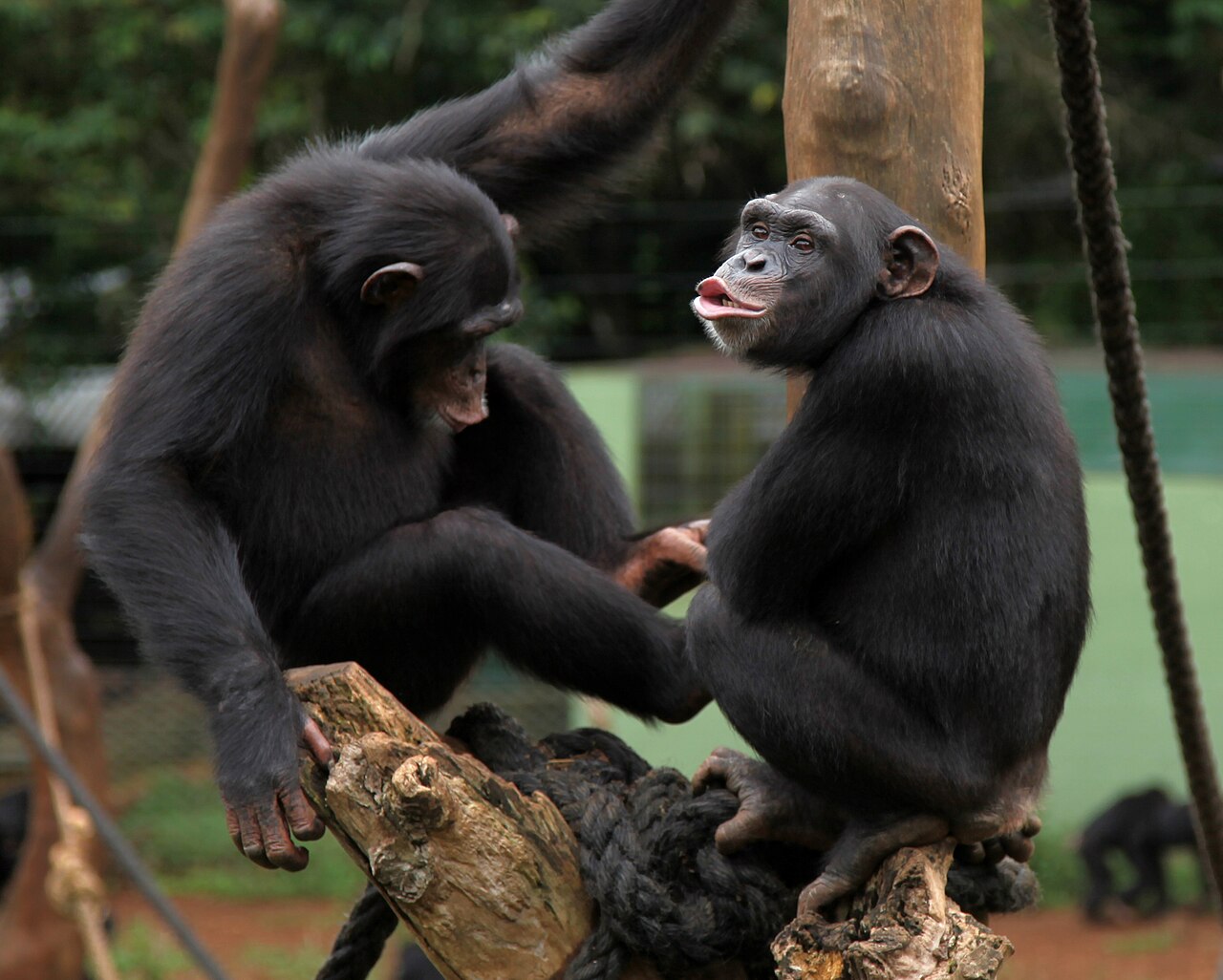

Among wild chimpanzees studied in Côte d’Ivoire, blowing a raspberry belongs almost entirely to grooming another animal. Among young, orphaned chimpanzees at a sanctuary in Sierra Leone, the same sound appears in a wider assortment of social situations. That difference opens an intriguing possibility: chimpanzees can possess a sound without yet having learned its community’s way of using it.
The research, described in a University of Warwick release republished by Phys.org and published in Proceedings of the National Academy of Sciences, concerns a small but consequential ingredient of communication. Knowing how to make a sound and knowing when it belongs are separate achievements. Human conversation depends on both; the chimpanzee findings suggest that social learning helps connect them in another ape.
The researchers compared 91 chimpanzees across four wild communities in Taï National Park and four communities at Tacugama Chimpanzee Sanctuary. The announcement is new, but the observations precede it: the researchers’ deposited data and code include records from 2019 through 2024.
A chimpanzee raspberry resembles the sound a person makes by blowing air through the lips. Researchers call it “unvoiced”: it is a mouth sound rather than a sound produced by vibrating vocal folds. In additional comments reported by SINC, study coauthor Richard Moore stresses that the important learning concerns when to use an existing sound. The chimpanzees need not invent or precisely copy a new one.
Three abilities therefore need separating. Sound production supplies the raspberry itself. Learning its social use connects it with a situation or purpose. A shared convention emerges when members of a community settle into a common pattern. A convention here means a shared practice; it need not involve an agreement anyone consciously negotiates.
The wild–sanctuary comparison helps examine that distinction. In the wild communities, raspberry use was concentrated around grooming. The sanctuary juveniles used it more broadly. If the connection between sound and situation were entirely fixed from birth, that flexibility would be harder to explain. The authors interpret the difference as evidence that experience with other chimpanzees helps shape a call’s use.
There is also a suggestive observation within the sanctuary. The researchers report that, after an adult joined one group, the group’s sound use gradually became more consistent and resembled the newcomer’s. Their interpretation is that adults can serve as models around whom a shared practice develops.
The public data add an important qualification. The deposited analysis includes several mouth sounds—raspberries, kisses, and teeth clacks or lip smacks. The changing group pattern should therefore be understood across those signals, rather than described as a raspberry-only result.
Our descriptive count of records for the sanctuary’s “A Group” illustrates the shift. Grooming accounted for 71 of 161 recorded events in 2022, about 44%, and 78 of 87 in 2024, about 90%. These figures come from the authors’ deposited data, pooling sound forms. They describe the share of recorded events occurring during grooming, not how much time the chimpanzees spent grooming.
They also require care. Ten individuals contributed records in the earlier year, compared with six in the later year. Both years are labelled as having a role model, so this calculation cannot establish a before-and-after effect of the adult’s arrival. More broadly, the wild and sanctuary groups differ in age, rearing history and social circumstances. The observations support the authors’ social-learning interpretation without isolating adult influence as the sole cause.
Shared sound use does not establish human language, nor reveal precisely what a chimpanzee understands about another’s intentions. Moore’s explanation to SINC is narrower: an animal may learn to use a familiar signal toward the same apparent end as its companions. Exactly how that learning works remains unresolved.
Even the connection with grooming has an unanswered physical question. Senior author Catherine Crockford proposes that lip movements used while removing parasites from another chimpanzee’s fur may make a raspberry particularly easy to produce. Different communities could independently discover its usefulness. That is a hypothesis requiring further research.
The revealing detail is where the sound settles. An animal’s mouth can supply a raspberry; life among other animals may help give it a customary place.
Sources
Discussion
Kind, curious discussion is welcome. Comments are checked before appearing. Requests to direct the newsroom are discarded.