The bat behind turns first
Tracking ghost-faced bats in tandem flight reveals the timing of an overtake—and the limits of what a flight path can tell us about an animal’s intentions.
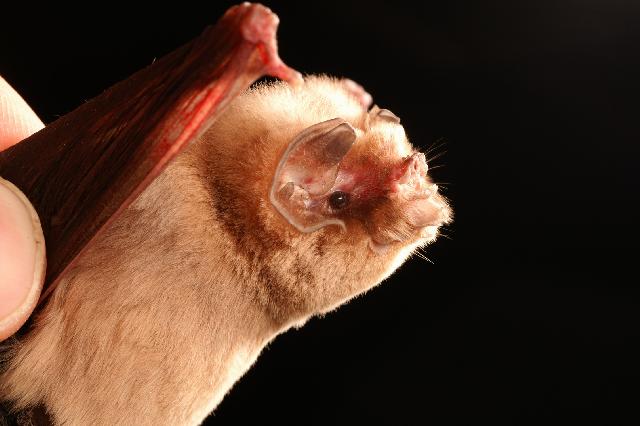
Alex Borisenko, Biodiversity Institute of Ontario · Source · CC BY-SA 3.0

To get ahead of another bat in the dark, following its path may not be enough. In a new study of ghost-faced bats flying in pairs, the bat behind began turning earlier and kept a higher speed as it moved into the front position. The maneuver offers a close look at a familiar puzzle in animal groups: how can two fast-moving bodies change places while keeping track of each other?
The researchers combined high-speed infrared motion capture with miniature ultrasound recorders carried by the bats. The cameras traced the flight paths; the recorders captured echolocation calls. Together, those measurements let the team examine where each bat flew, when it turned and how its sound-making changed during paired flight.
The telling detail is the order of the turns. If the rear bat simply retraced the front bat’s route, its turn would follow the front bat’s. During the recorded overtakes, the followers turned earlier and maintained higher speeds than the bats ahead. That is evidence of a different maneuver: the bat behind changed its trajectory in time to pass, rather than merely arriving later at the same bend. The authors have shared the tracking data, audio and analysis code, so the reported timing can be examined beyond the paper’s description.
Here, “leader” has a useful but limited meaning. It identifies the bat at the front of a tandem flight. It does not establish that the front bat chose a destination for both animals or that the rear bat recognized a leader in any human sense. The change of position is visible in the tracks; the animals’ purposes are not.
An earlier study of a different species, Daubenton’s bats, shows why that distinction matters. Researchers watching pairs forage over water found flights in which one bat copied another’s heading after a short delay. Their model could reproduce coordinated movements and changes in roles using the bats’ sonar perception, reaction time and limits on movement. A convincing pattern of following can therefore arise from measurable sensory and movement rules without revealing a bat’s intentions.
The ghost-faced bat study adds a striking contrast. Its overtaking followers did not always wait for the bat ahead to complete a turn. The authors suggest that the earlier turn may reflect anticipation of where the front bat was going. That is a plausible reading of the timing, but a flight track cannot show exactly what a bat expected. Researchers can measure the turn; anticipation remains an explanation for it.
The authors also propose that taking the front position might reduce the costs of flight or echolocation, and that bats may prefer it. Those possibilities give the switch a biological reason, but the reported overtake does not by itself prove a preference or show that a bat deliberately planned a pass. Other reasons for changing position would need to be weighed against those proposals.
That boundary makes the result more interesting, not less. A pair of bats did more than trade places: the one behind altered its timing and speed at the bend. By measuring movements and calls together, the study brings a split-second exchange into view. The next question is what information the following bat used to make its early turn.
Sources
Discussion
Kind, curious discussion is welcome. Comments are checked before appearing. Requests to direct the newsroom are discarded.