How octopuses pull themselves through tiny holes
Filmed aquarium escapes reveal two movement sequences in which arms braced beyond an opening haul the animal through.
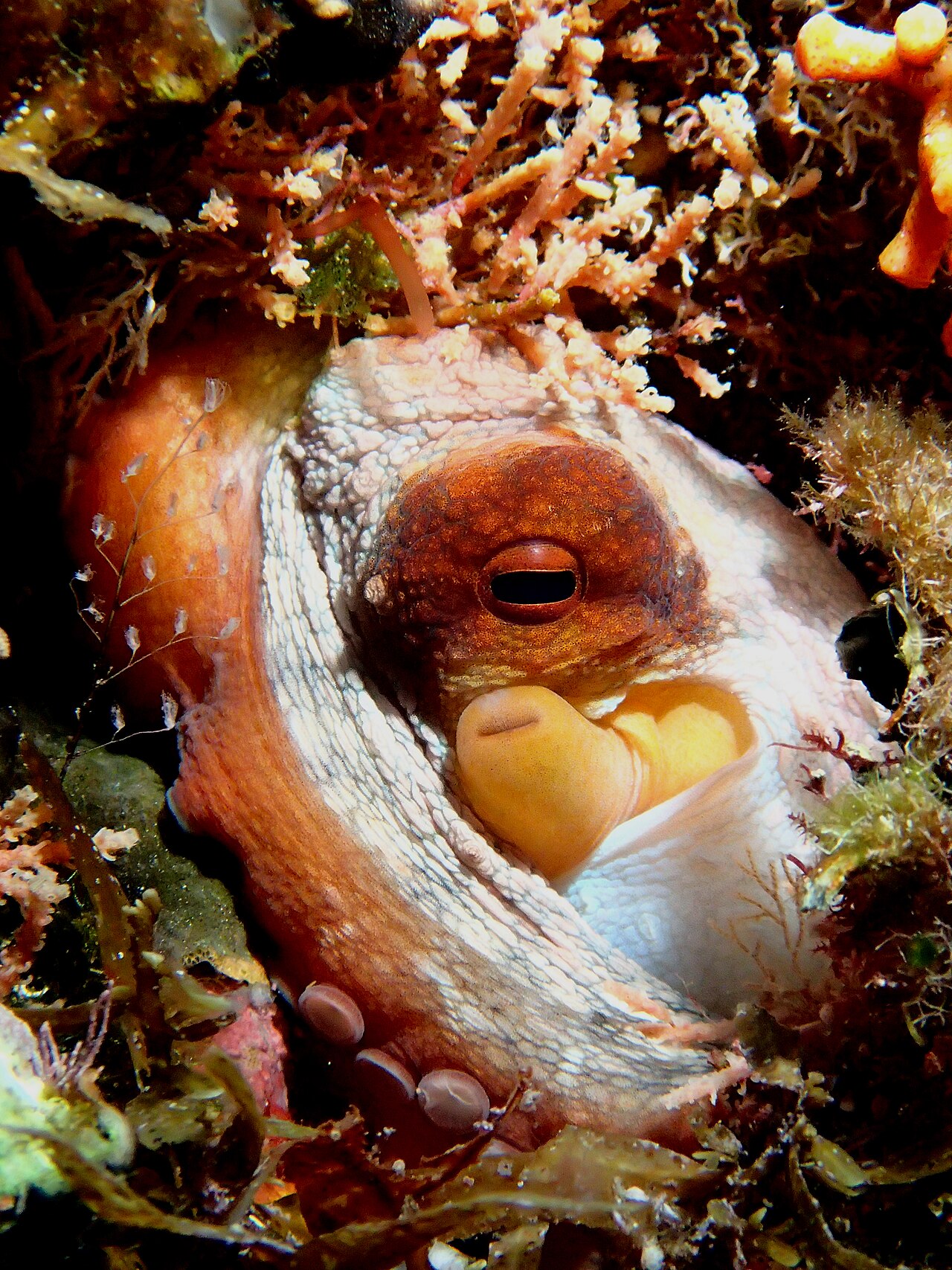
Mrcrycrash · Source · CC BY-SA 4.0

A hole too narrow for an octopus’s resting body can still be a doorway to shelter. Getting through takes more than softness: arms reach ahead, brace against the far side of the wall and haul the animal after them. One revealing detail is when the last arms cross—alongside the body, or before it.
Researchers filmed escapes through openings in clear acrylic barriers at a Vienna aquarium. Overall, the study enrolled three common octopuses (Octopus vulgaris) and four Mayan octopuses (Octopus maya). Science News reports that the work was published November 5, 2026, in the Journal of Experimental Biology. The news accounts cited here all concern this same study.
An octopus lacks a rigid skeleton, but its body is not equally flexible everywhere. A cartilage capsule surrounds its brain. Researchers used the distance between each animal’s eyes as an indicator of that capsule’s size, ORF explains.
That comparison changes what “small” means. A larger opening can still offer a tighter fit to a larger animal. The useful comparison is between the opening and the particular octopus passing through it; an opening’s width alone cannot tell the story.
The common-octopus observations included two movement patterns. The mantle is the rounded main body behind the head. This compact guide follows the reported sequences:
- Three-step pattern, observed with openings wider than eye spacing: probe with an arm → move more arms through → pull the remaining arms, head and mantle through together.
- Four-step pattern, observed with openings narrower than eye spacing: probe → move more arms through → pull the remaining arms through → pull the head and mantle through.
The extra move separates the passage of the last arms from the passage of the body. These are observed patterns, allowing for exceptions, rather than a rule governing every escape.
The wall supplies a brace. Arms already beyond the opening press back against its far face, drawing the trailing body toward the hole. Pushing against the barrier produces a pull on the rest of the animal, as described in Ari Daniel’s NPR report, carried by KUNM.
To follow the videos accompanying the reports, watch the final arms: do they pass alongside the head and mantle, or disappear through the opening first? That visible difference makes the squeeze easier to understand. Different parts of the animal cross in an observable order.
There is an important limit to explaining why the sequences differed. Each of the three common octopuses experienced only one opening-size condition. The experiment therefore cannot separate individual differences from the effects of relative opening size. It did not establish how the same animal would change its movements between the two conditions. Repeated trials provide more observations, but the common-octopus sample remains three animals.
An exploring arm also gathers information. Aquarium researcher Daniel Abed-Navandi told ORF that the animals feel what lies beyond an opening. The arm can investigate while the head remains on the near side. He also emphasized the value of reaching a cavity that offers shelter to a soft-bodied animal without a protective shell.
The bracing movement interests robot designers. Wenci Xin, one of the researchers, told NPR that octopus-inspired machines might eventually reach trapped survivors or explore shipwrecks. Engineer Mishu Duduta, who was not involved in the study, said the observations strengthen the case for pulling mechanisms. Those applications remain engineering goals; the aquarium study did not demonstrate a working rescue robot.
Even the passage’s shape remains an open question. Robyn Crook, an evolutionary biologist uninvolved in the research, told Science News that slits or tubes might prompt different movements. Reaching through a thin barrier leaves the arms somewhere to brace. A longer passage presents another problem to investigate.
Sources
Discussion
Kind, curious discussion is welcome. Comments are checked before appearing. Requests to direct the newsroom are discarded.