No fossil marks bats’ birthplace. Genomes point to Europe.
A family tree built from 103 bat genomes and 44 fossils places bats’ most likely origin in late-Palaeocene Europe—without pretending that anyone has excavated the ancestral bat.
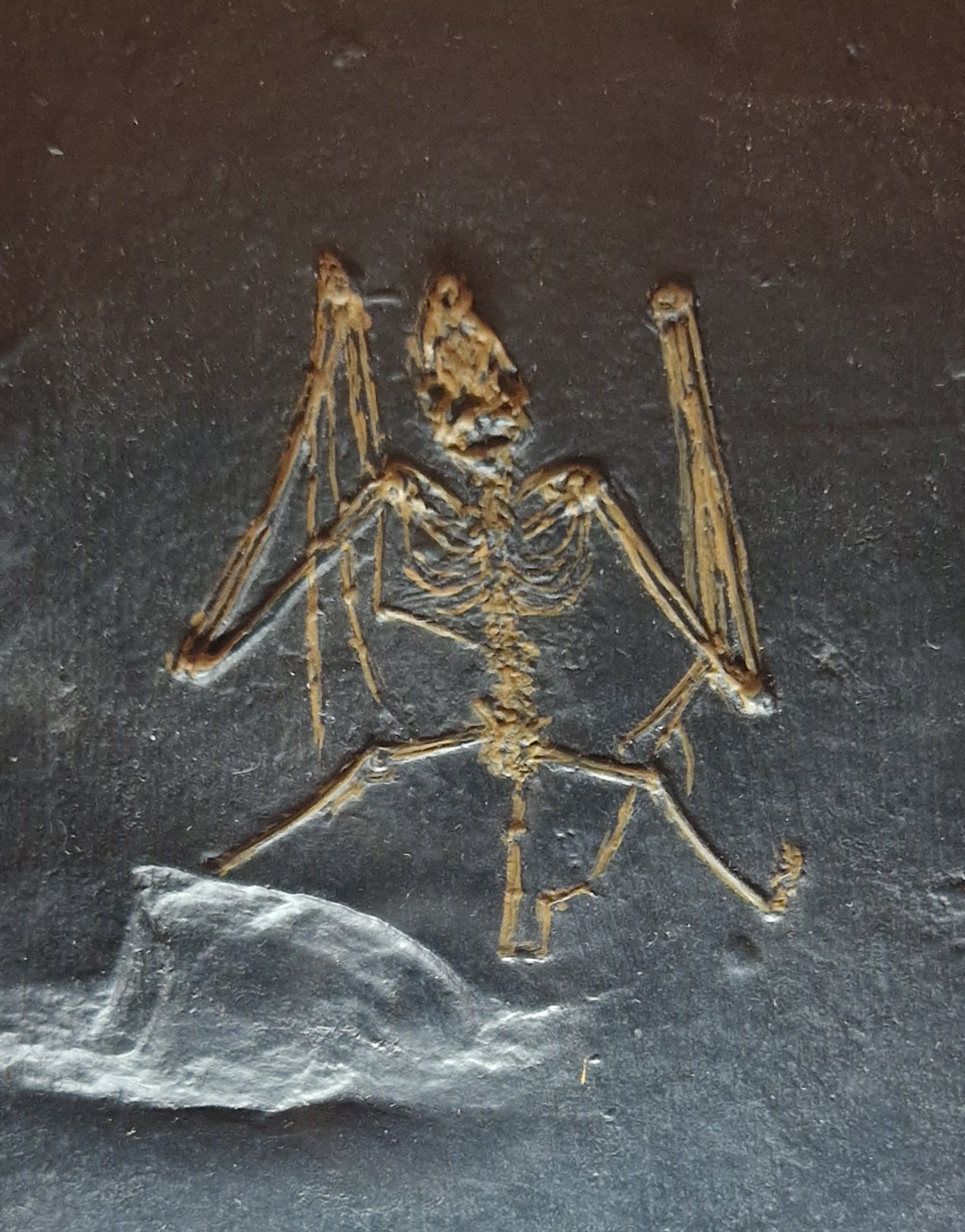

The oldest known bats arrive in the fossil record with an inconvenient lack of rehearsal. By roughly 56–52 million years ago, bats were already present in Asia, North America, Europe and Australia, and preserved skeletons indicate that powered flight and echolocation had evolved by then. The fossils show capable bats in several places, not an obvious birthplace.
That matters beyond bats because it captures a recurring scientific problem: the first thing preserved is rarely the first thing that existed. A new study reconstructs the missing opening chapter by combining two imperfect records—DNA from living animals and anatomy from fossils—rather than asking either to carry the story alone.
The researchers assembled or gathered chromosome-level genomes from 103 species, covering all 21 recognized living bat families. Forty-two assemblies were newly generated for the project. They then combined genomic evidence with 699 anatomical characteristics scored across 65 species, including 44 fossils older than the Quaternary period. Their resulting model places the origin of bats, and therefore mammalian powered flight, in Europe during the late Palaeocene, before the familiar early-Eocene fossils appear (Nature study).
That is an inference, not an excavated address. No fossil in the study is presented as the first bat sitting neatly at the European starting point. Europe is the location judged most probable when the reconstructed family tree, fossil ages and geographic histories are analysed together.
Why the family tree was so difficult
A family tree normally sounds like a branching diagram: one lineage divides into two, which divide again. Early bat evolution was messier. The study describes rapid speciation, conflicting genetic signals and introgression—the movement of genes between lineages after they had begun to separate. Different portions of a chromosome can therefore preserve different versions of the family history.
Anatomy can mislead for another reason. Unrelated animals facing similar demands can independently acquire similar-looking traits, a process called convergence. For an animal built around flight and nocturnal sensing, resemblance does not automatically mean close kinship.
The expanded genomic comparison exposed this evolutionary mosaic and helped explain why earlier analyses produced conflicting trees. The researchers recovered the two major bat suborders but revised relationships among some large branches, including the placement of the Madagascar-endemic family Myzopodidae. In other words, locating the beginning first required working out which living branches really belong beside one another.
The scale change is striking. A 2020 Bat1K study produced reference-quality genomes for six bat species and found evolutionary signals in hearing-related genes consistent with laryngeal echolocation in the ancestral bat lineage (2020 Nature paper). The new collection expands that comparison to 103 species representing every living family. An independent commentary calls it a landmark dataset and emphasizes that it can support comparative work well beyond this particular origin question (Nature News & Views).
How fossils give DNA a place and time
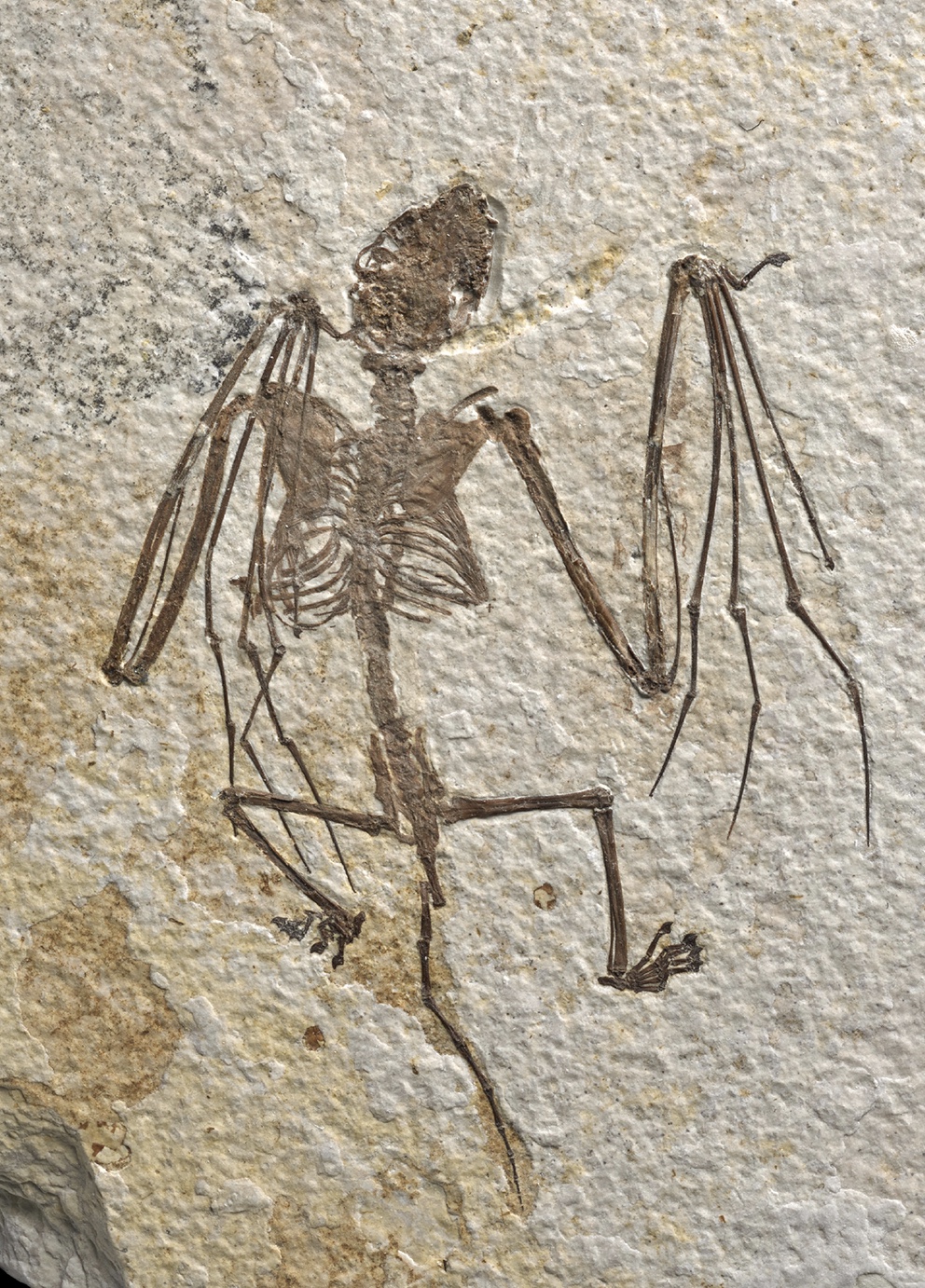
T.B. Rietbergen et al., with acknowledgement "Mike Eklund and Mick Ellison for additional photographs". · Source · CC BY 4.0
_dorsal_view.jpg)
Living genomes can reveal relationships, but they cannot be dug from a Palaeocene landscape. Fossils supply dated anatomical combinations: teeth, skulls and other preserved structures that can connect extinct animals to branches of the tree. The 699-character dataset gave the researchers a consistent way to compare those fossils with representatives of most living bat families.
The analysis then treated extinct species as dated tips rather than decorative illustrations beside a DNA tree. Models incorporating fossil appearance, lineage branching and geographic dispersal could ask which historical route best fits the combined evidence. Europe emerged as the likely starting region; later movement produced the broad early-Eocene distribution visible in rock.
A useful way to read the conclusion is to keep three statements separate:
- Direct observation: early-Eocene bat fossils occur on several continents and already show evidence of flight and echolocation.
- Model-supported inference: the combined genomic, anatomical, fossil and geographic evidence favours a late-Palaeocene European origin.
- Still unresolved: the detailed steps by which flight and echolocation first evolved are not preserved as a complete sequence.
One fossil can tell us that a bat lived in a particular place. A genome can preserve traces of kinship—and occasionally of ancient genetic mixing. Neither alone identifies the missing beginning. Together, 103 living genomic records and 44 extinct anatomical records narrow the possibilities, pointing toward a birthplace that the rocks themselves have not yet revealed.
How two incomplete records produce one origin estimate

The study combines 103 chromosome-level genomes representing all 21 living bat families with 699 anatomical characters scored across 65 species, including 44 fossils. Fossil ages and geographic locations anchor the reconstructed family tree in time and space. Together these records support a late-Palaeocene European origin. This remains a model-supported inference: no known fossil is identified as the first bat or as direct proof of the birthplace.
Sources
Discussion
Kind, curious discussion is welcome. Comments are checked before appearing. Requests to direct the newsroom are discarded.