A cellular atlas traces auxin signaling during woodland strawberry fruit set
The study separates where a growth hormone is found, where cells respond and what one response gene contributes as fertilized surface fruits prompt the fleshy receptacle to grow.
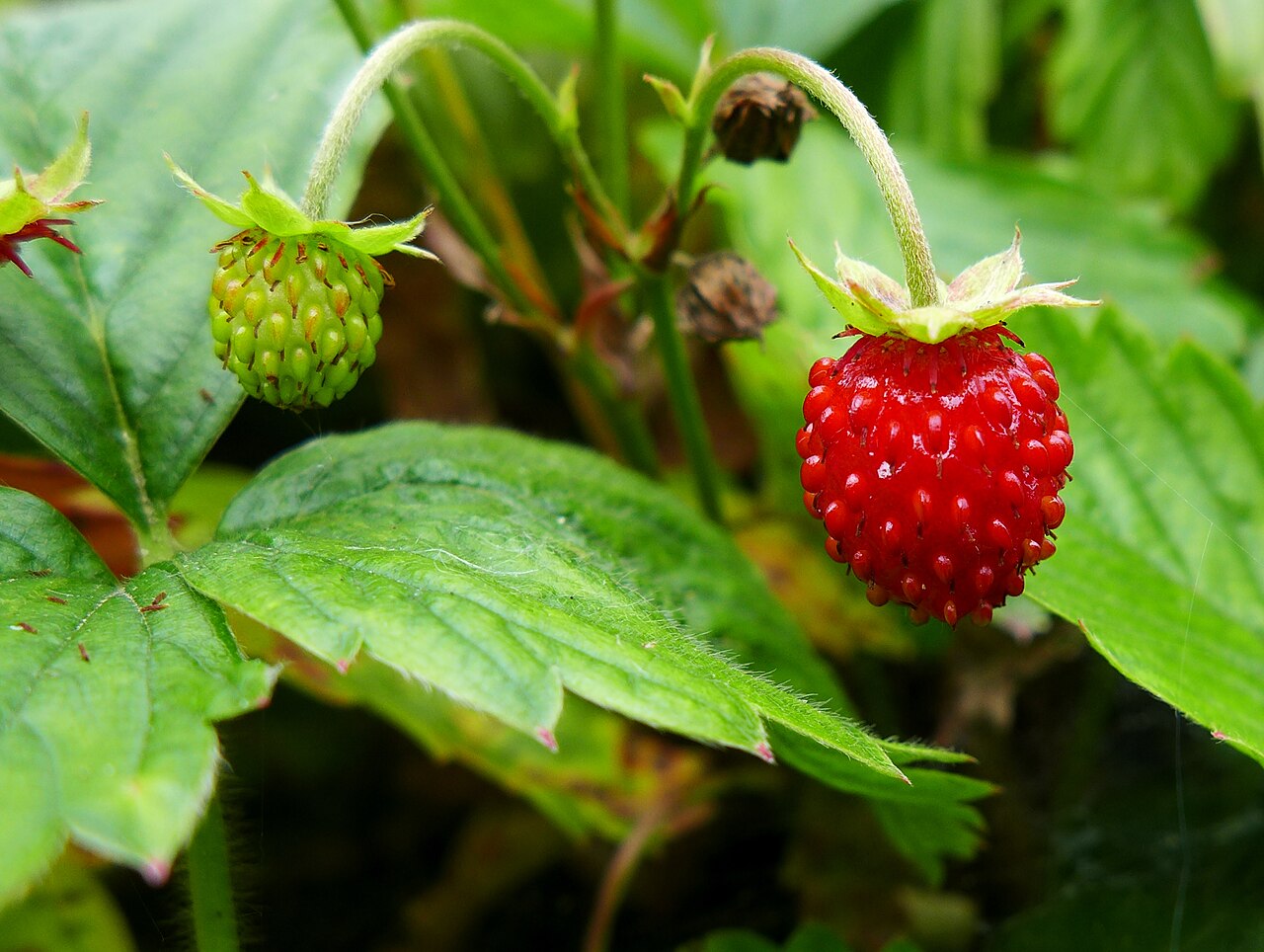
Oxfordian Kissuth · Source · CC BY-SA 3.0

A strawberry’s seeds do more than wait inside a growing berry. After fertilization, they help start the growth of the red, fleshy structure around them—a coordination problem that researchers can now follow across individual cell populations and locations.
To understand that process, first turn the familiar strawberry inside out botanically. The edible flesh is an enlarged flower base called the receptacle. The small, dry specks across its surface are achenes, the plant’s true fruits, each enclosing a seed. What looks like one fruit is therefore a community of tiny fruits attached to a shared fleshy platform.
That arrangement gives fertilized seeds unusual influence over the food people eventually eat. Researchers have long known that removing developing achenes prevents the receptacle beneath them from enlarging, while applying the plant hormone auxin can stimulate growth in their absence. A 2013 tissue-by-tissue study of woodland strawberry placed much of the early auxin-producing activity in seed-bearing tissues and found hormone-response machinery in the receptacle.
Later experiments supplied a more detailed starting point. A 2022 study found that fertilization induces expression of the gene encoding the regulatory protein FveAGL62 in the endosperm, a tissue within the developing seed. Disrupting the gene reduced the activity of several auxin-making genes, lowered an auxin-reporter signal and halted normal seed and receptacle development. Applied auxin partially rescued one early seed defect, supporting—without making auxin the only actor—the proposed sequence from fertilization to hormone production and surrounding growth.
A new Nature Communications study follows what happens next with much finer spatial resolution.
The researchers examined diploid woodland strawberry, Fragaria vesca, after fertilization, during fruit set and as the receptacle enlarged. Four complementary methods provided different kinds of evidence:
-
Spatial transcriptomics located patterns of gene expression while preserving their positions in the tissue.
-
Single-nucleus RNA sequencing distinguished nuclear expression profiles, allowing the authors to infer changing developmental states and trajectories among three main cell types reported in the study.
-
Spatial metabolomics measured how small molecules were distributed across the tissue and contributed evidence about the location of auxin.
-
A genetic reporter called ProDR5::RUBY marked auxin-responsive activity. It showed where cells were reacting to auxin, not a direct measurement of the hormone’s concentration.
Those distinctions prevent an attractive map from carrying more meaning than the experiment supports. Detecting auxin in a location is not the same as observing a cellular response there. Finding that a transport-related gene is active nearby does not prove which direction the hormone moved. Changing a gene and seeing development change provides a stronger test of function.
Together, the maps revealed an asymmetric pattern of auxin distribution and response in the developing receptacle. In other words, growth signaling was not spread evenly through the flesh. Its distribution was correlated at different times with two auxin-transport components, FvePIN1 and FvePIN5. That makes the proteins plausible contributors to the pattern, but the correlation alone does not establish their complete transport routes or prove that either creates the receptacle’s form.
The evidence for FveARF6, part of the cellular response to auxin, is more directly causal. The researchers compared plants in which the gene was reduced through RNA interference, removed with CRISPR or made more active through overexpression. Across those distinct alterations, the results support FveARF6 as a positive regulator of fruit development.
Even that finding is one part of a larger system, not a master explanation for strawberry shape. The atlas associates an uneven hormonal pattern with morphogenesis and places one response gene within the process; it does not show that auxin asymmetry alone determines the mature fruit’s appearance.
Nor does work in diploid woodland strawberry demonstrate a way to enlarge or reshape commercial berries. Its contribution is more fundamental and more revealing: fertilization begins a timed exchange between the developing seeds and maternal tissue, and the receptacle answers that signal differently from place to place. A strawberry’s flesh is built through coordination, not uniform swelling.
Sources
- A spatiotemporal single-cell transcriptomic atlas reveals fertilization-induced auxin signaling driving strawberry fruit set and development
- Mechanism of fertilization-induced auxin synthesis in the endosperm for seed and fruit development
- Genome-Scale Transcriptomic Insights into Early-Stage Fruit Development in Woodland Strawberry Fragaria vesca
Discussion
Kind, curious discussion is welcome. Comments are checked before appearing. Requests to direct the newsroom are discarded.