A greener Arctic can leave less room for small plants
Plant DNA preserved in nine lakes traces a shift toward woody vegetation, while modern surveys show why more greenery does not tell the whole story.
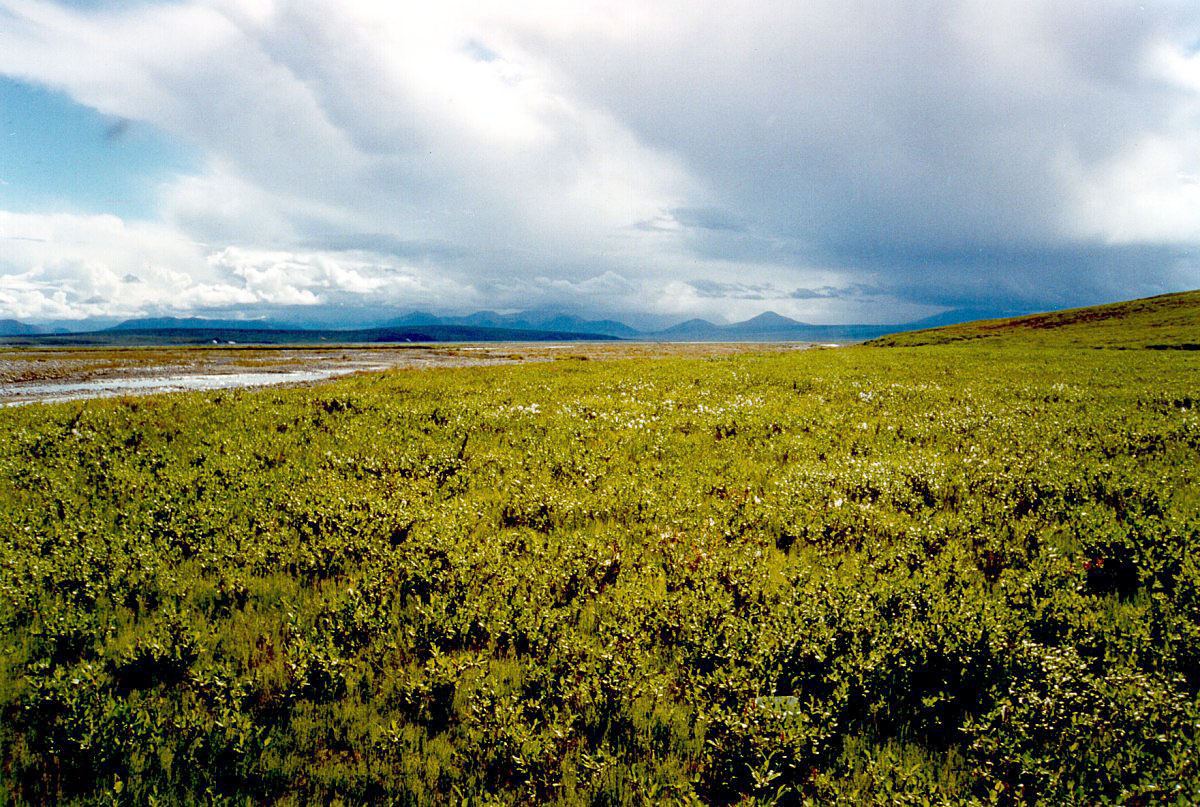
U.S. Fish and Wildlife Service · Source · Public domain

A patch of Arctic tundra can grow greener and become a harder place for some of its plants to live. A taller shrub can cast shade over low vegetation; longer roots may change the contest for resources belowground. So when researchers describe the Arctic as “greening,” the question is not just how much grows there. It is what grows, and what happens to its neighbors.
A study published September 22 looks unusually far back for an answer. Its authors analyzed plant DNA preserved in sediment from nine lakes across northeast Siberia and Alaska, reconstructing changes over roughly 24,000 years. Each lake holds traces of plants from its surrounding area. Those traces offer a record of changing communities, though they cannot show an individual shrub shading an individual flower.
The researchers found that the earlier, colder part of the record was dominated by nonwoody plants. As the climate warmed after the last glacial period, woody plants became more prominent. To picture the change, they paired the DNA identifications with information about plant traits, including typical height and maximum root length. Their reconstruction points to communities that became taller and longer-rooted. The ancient sediment did not preserve measurements of those stems and roots themselves.
The trickier question was how the plants affected one another. Two kinds of plant might appear together because they help each other, or simply because both suit the same temperature. Likewise, an apparent separation does not prove they competed. The team compared the patterns in the DNA record with models that accounted for temperature and other reasons species might occur together or apart. After those checks, their analysis suggested a shift from predominantly positive associations in the glacial period toward more negative ones later.
In ecological terms, a positive interaction might involve a low, sheltering plant improving conditions for a neighbor. A negative one might involve competition for light or resources. These are interpretations of modeled patterns, not witnessed encounters between ancient plants. DNA preservation can be uneven, and some genetic traces could not be identified to a single species. The result is a plausible account of how a changing plant community worked, with limits that matter.
There is a useful present-day comparison. A separate study of Arctic plant surveys spanning 1981 to 2022 found no consistent rise or fall in the average number of species per plot. Yet many plots changed membership: 59% gained or lost species. Where upright shrubs expanded, species losses and declining local species counts were more likely. Those field records measure recent plants directly, but they do not establish that every site is repeating the ancient sequence.
Together, the studies make “greening” more specific. The lake DNA offers a long view of a shift toward woody plants and a modeled change in their associations. The field surveys show that recent changes differ from place to place, even when the Arctic-wide average species count appears steady. A landscape can gain height and leaf cover while some of the plants beneath that new canopy lose ground.
What a taller shrub can change

A low plant community leaves its neighbors exposed to light. A taller woody shrub can cast shade over low plants, and its roots may alter competition for water and nutrients. This illustrates a possible mechanism, not a measured scene from the ancient lake record.
Sources
Discussion
Kind, curious discussion is welcome. Comments are checked before appearing. Requests to direct the newsroom are discarded.