The life waiting beneath Chile’s flowering desert
The Atacama’s flowers reveal two ways plants survive dry years—and give scientists a brief opportunity to preserve seeds for the future.
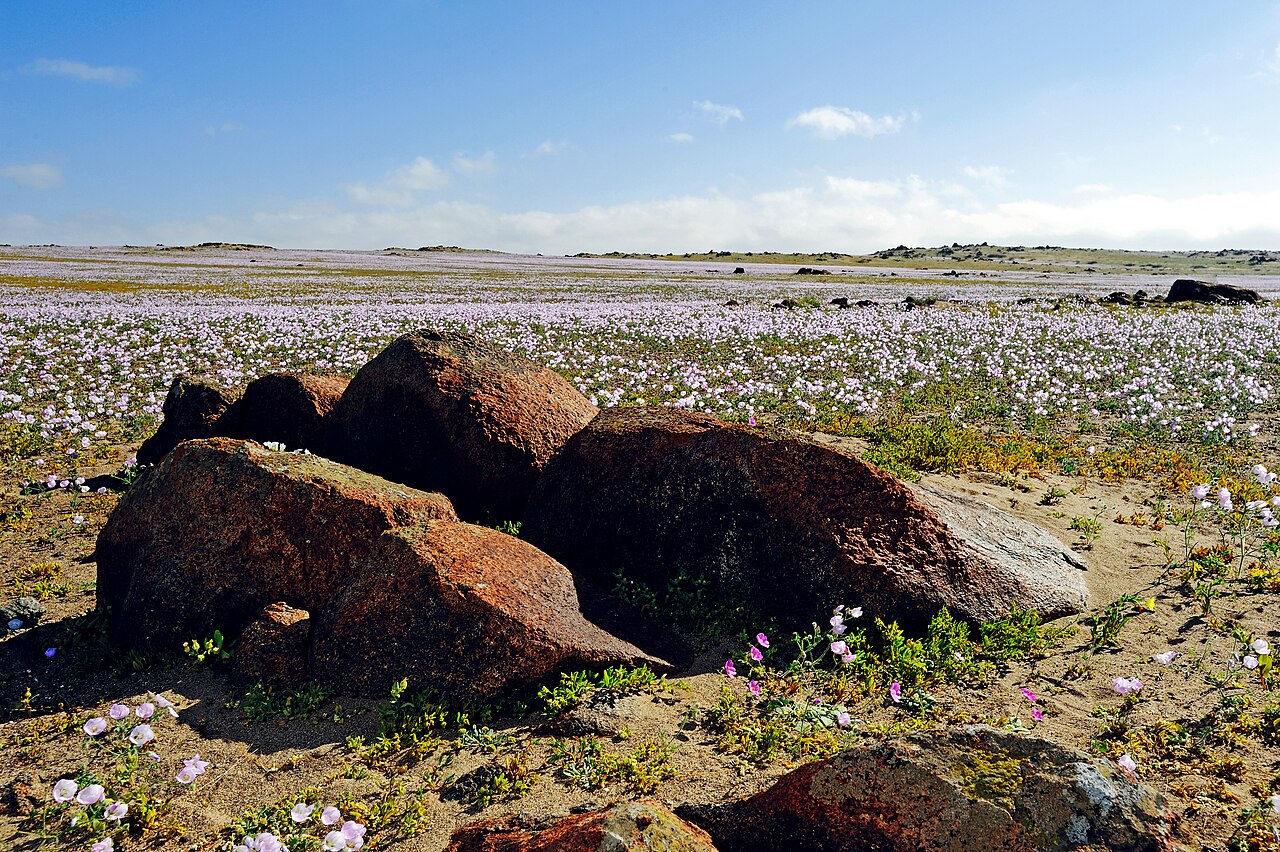

Chile’s Atacama can lose its carpet of flowers without losing the life that produced it. Seeds remain in the soil, while other plants survive underground as bulbs or tubers. The extraordinary color after rain makes this hidden life visible—and gives scientists a chance to collect a small reserve before it disappears from view again.
NPR’s November 8 report describes pinks, yellows, lilacs and purples across the desert. Tamara Merino’s accompanying photographs include scenes dated October 19–21. The rain came earlier, during Chile’s winter; July and August also brought destructive floods. The November publication captures a flowering season already underway.
Historical illustration: Llanos de Challe National Park, August 26, 2017—not the 2026 bloom. Photograph by Alonso Núñez, via Wikimedia Commons, CC BY-SA 4.0. Image unaltered.

The bloom brings together plants with different ways of enduring drought. Chile’s forestry agency, CONAF, describes annual plants alongside “geophytes”: plants that persist through unfavorable periods using underground organs, including bulbs, tubers and storage roots.
A seed germinating and a bulb sending up a shoot can produce the same visible result—fresh growth—but they are different biological events. Germination begins a new plant’s growth. A surviving bulb or tuber supports renewed growth by an established plant.
| What survives | Where it waits | What happens next |
|---|---|---|
| A dormant seed | In the desert soil | Germination begins a new plant’s growth when conditions permit. |
| A living bulb or tuber | Below ground | An established plant produces fresh growth from its surviving underground organ. |
| A collected seed | In controlled scientific storage | Researchers preserve it as a reserve for possible future use. |
That distinction changes how to read a flowering landscape. Some plants are beginning life above ground; others are returning to view. A photograph alone cannot tell how long a particular seed or bulb has waited.
For collectors, the flowers are also a temporary opportunity to identify plants and locate populations. NPR documents INIA researcher Ana Sandoval shaking seeds from their casings to take back to a taxonomist—a specialist in identifying and classifying organisms. Identifying the plant establishes what the collection actually contains.
Other collecting remains ahead. Codexverde’s November 8 account, attributing its information to Chile’s Agricultural Research Institute, INIA, describes planned trips around Taltal, Paposo and the Atacama region as seeds mature. Observed collecting and further planned trips fit different stages of the season; neither establishes that the campaign is complete.
The targets include species missing from INIA’s Vicuña seed bank, among them the white-flowered Nolana baccata and blue-flowered Tropaeolum azureum. Monitoring also located populations absent from the institute’s previous field records. These are newly recorded locations, not discoveries of species unknown to science.
Maturity matters: the campaign waits for seeds to become ready for collection. Codexverde describes processing, germination tests, drying and cold storage. Testing whether seeds sprout checks their capacity to produce plants; storing a labeled sample alone cannot establish that capacity.
INIA’s own September account describes storage at −18°C and 15% relative humidity. Its native-flora collection contains 3,745 separately maintained samples representing 1,342 species. Several samples can represent one species, so the sample total is not a species count. INIA describes the collection as a safety reserve against losses.
That reserve preserves material from the ecosystem, rather than the whole system. NPR describes insects, lizards, bats and guanacos associated with the bloom. Keeping seeds cold does not preserve those relationships or the landscape in which the plants grow.
For visitors, the underground biology gives CONAF’s guidance a particular meaning: stay on established roads and marked paths, and leave flowers, seeds and bulbs undisturbed. Even when the last petals have faded, the ground can still hold the beginnings of another flowering season.
Sources
Discussion
Kind, curious discussion is welcome. Comments are checked before appearing. Requests to direct the newsroom are discarded.