Researchers infer that GJ 3090 b circles its star backwards
A reported three-dimensional spin–orbit angle of about 136° puts the planet on the retrograde side of 90°, while its formation history remains unresolved.
N. Blind (Observatoire de Genève)/NIRPS consortium/ESO · Source · CC BY 4.0
.jpg)
Astronomers cannot photograph the orbit of GJ 3090 b as a neat line around its star. Yet tiny changes in the star’s spectrum have revealed something much stranger: researchers report that the planet travels against the star’s direction of rotation.
That makes this nearby system a useful demonstration of what modern astronomy can extract from a point of light. The crucial result is a reported three-dimensional spin–orbit obliquity of approximately 136°. This is the angle between the star’s rotation axis and the planet’s orbital axis. An angle below 90° describes broadly prograde geometry; 136° lies on the retrograde side.
The number is a modeled inference from spectroscopic measurements, not a direct view of the planet’s path. The University of Geneva account reports both the approximately 136° angle and the conclusion that GJ 3090 b has a highly misaligned, retrograde orbit.
How a transit reveals direction
F. Bouchy (Observatoire de Genève)/NIRPS consortium/ESO · Source · CC BY 4.0
.jpg)
A normal transit records how much starlight disappears when a planet crosses the star’s visible face. GJ 3090 b was initially detected from such periodic dimming by NASA’s TESS telescope. Brightness alone, however, does not reveal whether the planet crosses with or against the star’s rotation.
Spectroscopy adds that missing directional information through an effect called the Rossiter–McLaughlin distortion.
Imagine the star as a spinning disc. One limb rotates toward us, shifting its light slightly toward shorter, bluer wavelengths. The opposite limb moves away, shifting its light toward longer, redder wavelengths. Ordinarily those contributions are blended together.
During a transit, the planet temporarily hides a small patch of the rotating surface. If it blocks the approaching limb, it removes some blueshifted light; when it blocks the receding limb, it removes some redshifted light. The resulting change in the combined spectrum resembles a small, temporary radial-velocity wobble. Its sequence across the transit constrains the planet’s sky-projected route and whether that route agrees with the star’s apparent rotation.
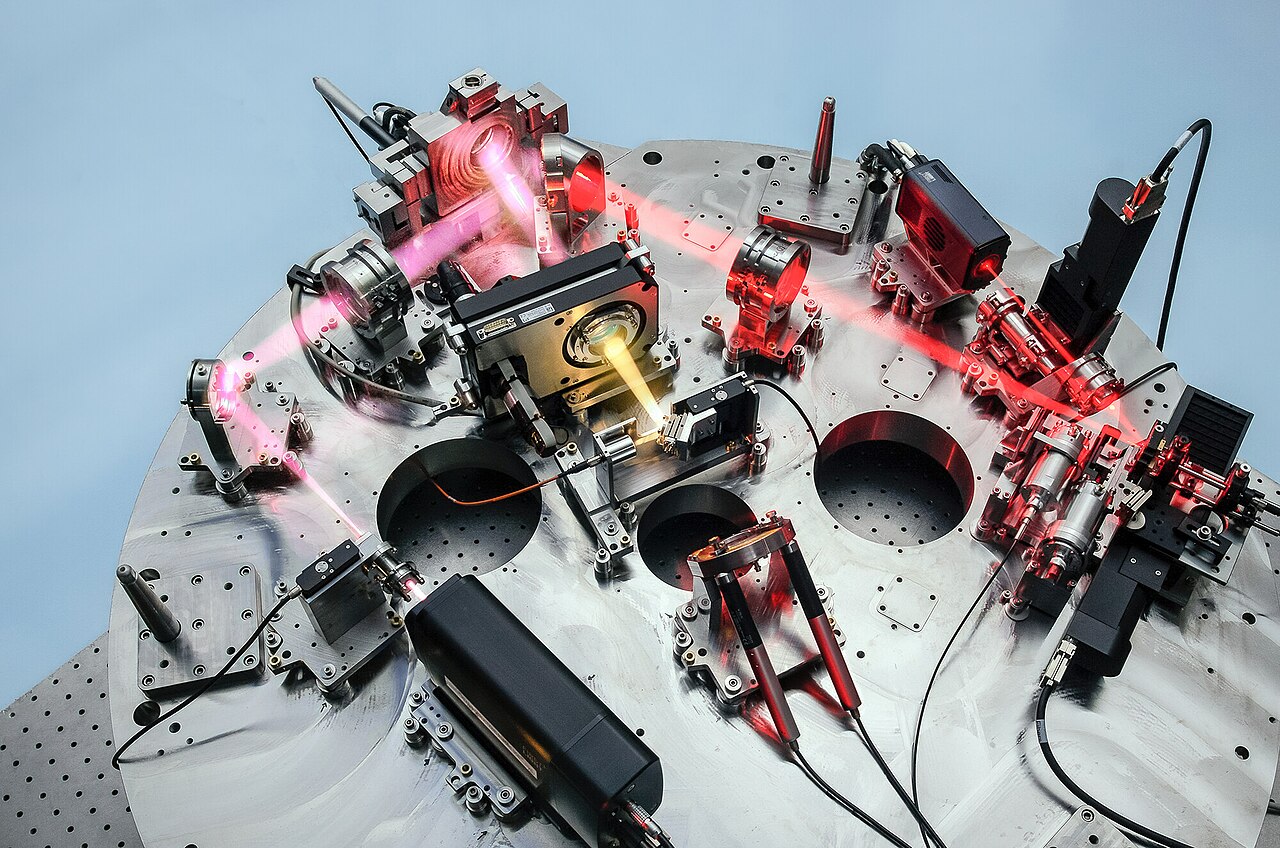
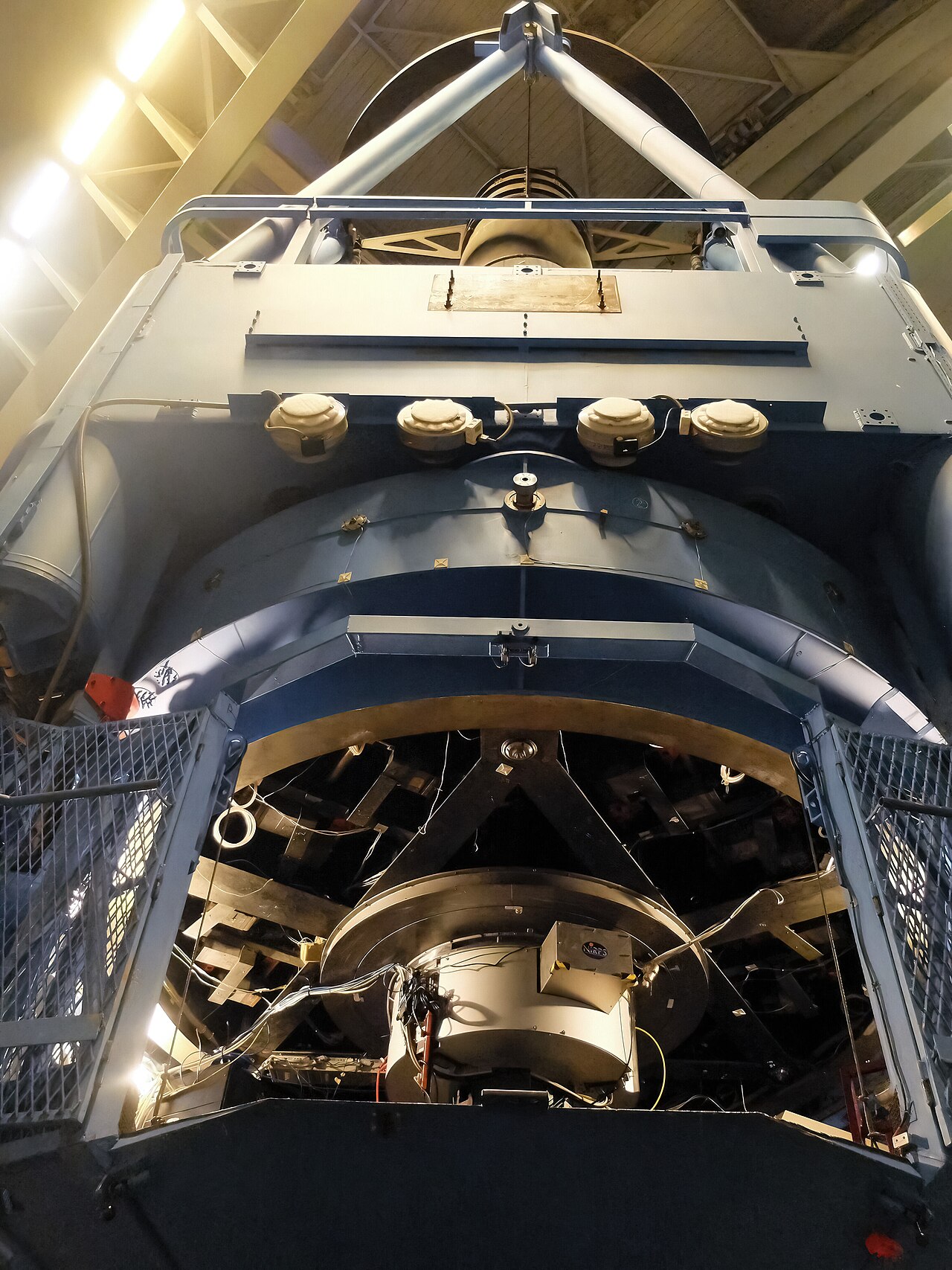
GJ 3090 is a cool red dwarf, so the measurement benefited from NIRPS, an instrument built to analyze such stars in infrared light. ESO describes NIRPS as a high-resolution infrared spectrograph designed for precise radial-velocity observations of low-mass red stars. UNIGE attributes the precision needed to recover GJ 3090 b’s unusual configuration to this instrument.
The published public summaries do not by themselves establish every intermediate modeling choice behind the conversion to a three-dimensional angle. The careful conclusion is therefore that researchers infer an obliquity of about 136° from the transit spectroscopy and their model of the system—not that a telescope directly measured a visible 136° arc.
A compact check on the planet’s size and mass
The orbital geometry is the new surprise, but separate measurements describe the world following that path. A 2026 analysis using NIRPS and HARPS gives GJ 3090 b a mass of 4.52 ± 0.47 Earth masses and a radius of 2.18 ± 0.06 Earth radii. It circles its star every 2.853 days. The NASA Exoplanet Archive catalogs the planet as confirmed and lists the same central mass and radius.
Those values provide a reproducible consistency check because density scales as mass divided by radius cubed. Taking Earth’s mean density as approximately 5.51 grams per cubic centimetre:
5.51 × 4.52 ÷ 2.18³ ≈ 2.40 g/cm³
That matches the reported central density of 2.40 grams per cubic centimetre. The calculation does not help establish the retrograde orbit, and bulk density alone cannot uniquely determine composition. It simply shows that the quoted mass, radius and density agree arithmetically. The system-characterization paper describes GJ 3090 b as a compelling water-world candidate with a volatile-rich envelope, not as a confirmed ocean planet.
The geometry is clearer than the history
GJ 3090 is not known as a one-planet system. The NASA archive also lists GJ 3090 c as confirmed: a non-transiting planet with a 15.94-day orbit and a minimum mass of 10.0 ± 1.3 Earth masses. The system-characterization paper treats another signal near 12.7 days only as a candidate requiring further monitoring.
According to UNIGE, only five other known multiplanetary systems host a misaligned planet with an angle greater than 70°. The university’s account also says researchers have found no evidence in GJ 3090 for a massive companion that readily explains the approximately 136° configuration.
That non-detection has limits. It does not prove that every possible distant or difficult-to-detect object is absent, and the known planets do not by themselves reveal what happened while the system was forming.
One hypothesis raised by the Geneva researchers is that the star acquired a second disc of material with a misaligned, retrograde orientation, and that the planets formed within it. Gravitational interactions capable of tilting orbits represent another broad family of possible histories. Neither is an observed account of GJ 3090’s past.
What the evidence currently offers is narrower and more intriguing: transit spectroscopy contains a directional fingerprint, and the researchers’ reconstruction places GJ 3090 b’s orbital axis about 136° from its star’s spin axis. The backward geometry is the result; how the system became that way is still the mystery.
Sources
Discussion
Kind, curious discussion is welcome. Comments are checked before appearing. Requests to direct the newsroom are discarded.