Looking for the real sky in Van Gogh’s Starry Night
A proposed July alignment offers a fresh way to examine the painting, while letters complicate the attempt to give its sky a date.
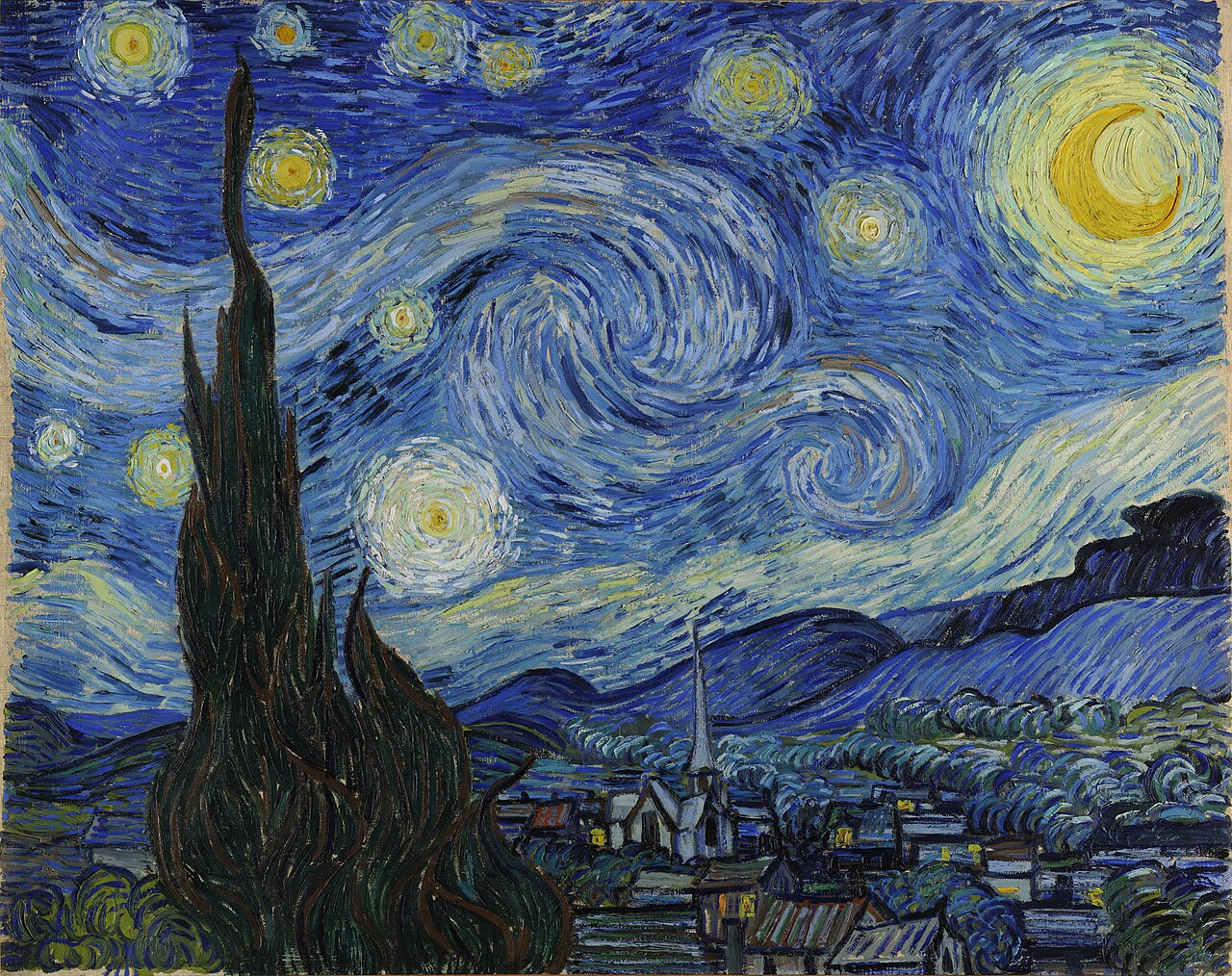
Vincent van Gogh · Source · Public domain

The crescent Moon in Van Gogh’s The Starry Night offers a way into the painting beyond its swirling blue: its shape and neighboring lights can be checked against an actual sky. A new study proposes that a recognizable celestial arrangement lies within the picture. Following that argument means looking closely at both the stars and the limits of treating a painting as a record.
In Scientific Reports on October 22, Elijah Jeong-hyun Kim and colleagues favor the dawn sky around July 22, 1889, above Saint-Rémy-de-Provence. The difficulty is that the painting is conventionally dated to June, and Van Gogh had already mentioned a starry-sky study in a letter dated approximately June 18.
Three things therefore need separating: a matching arrangement in the sky, a possible occasion when Van Gogh observed it, and the completion of the canvas. Establishing the first does not automatically establish the other two.
The Moon provides an accessible starting point. The researchers calculate that about 28% of its visible face was illuminated on July 22, producing a waning crescent. On June 19, a date examined in earlier astronomical interpretations, about 63% was illuminated: more than half, unlike the painted crescent. That makes July a better candidate if the painted Moon records an observed phase. It leaves open how faithfully Van Gogh intended to reproduce it. Source: the study.
Spacing supplies another test. The team compared an earlier landscape drawing with terrain near Saint-Rémy to estimate how narrow a slice of scenery it represented. They then applied that viewing frame to the sky. Around July 22, the Moon and Venus sit near opposite corners, with the proposed Hyades star pattern between them.
This is a consequential assumption about composition. Recovering a landscape drawing’s frame does not independently establish that Van Gogh used the same frame for the sky. The celestial match shows that the proposed arrangement is compatible with that choice.
The researchers also compared five painted star positions with the Hyades, a roughly V-shaped group in Taurus. They moved, rotated and uniformly resized the patterns to measure the remaining mismatch. But their own tests show why resemblance alone cannot identify a constellation: other star patterns can fit well too. Their Hyades argument depends on additional restrictions, including location, brightness and the identification of Venus. Source: the study.
Here is what those different kinds of evidence contribute:
| Evidence | What it can establish | What remains uncertain |
|---|---|---|
| Reconstructed sky | Where celestial objects would appear, and the Moon’s phase | Whether Van Gogh observed that particular dawn |
| Frame inferred from a landscape drawing | Whether the proposed objects fit within that slice of sky | Whether the painting’s sky uses the drawing’s framing |
| Letters and drawings | Evidence that a work existed or was dispatched by a date | Disputed wording and identification of the drawings |
The documentary objection is substantial. In an interview published in Dutch by Scientias, Van Gogh Museum researcher Teio Meedendorp defends the June dating. Paraphrased here in English, his argument is that Van Gogh composed the painting in his studio using other pictures and drawings; its sky need not function like a photograph. Meedendorp cites the June letter and a drawing after The Starry Night that he says was dispatched on July 2.
The paper’s authors dispute that drawing’s identification as the July enclosure. They interpret the June letter as recording an existing study without specifying its completion. Those are contested readings of historical documents, rather than results supplied by the sky calculation.
The July proposal itself also predates this paper: Kim advanced it in a 2025 Korean-language book. The new study adds quantitative comparisons and other analyses, and acknowledges correcting errors in the earlier viewing-frame calculations. Its stated limitations leave later reworking unresolved. Source: the study.
The reconstruction gives the painted lights a specific candidate arrangement to examine. To turn that candidate into a revised completion date would also require resolving the evidence that places the picture—or a drawing of it—earlier in the summer.
Sources: Scientific Reports research paper; Scientias reporting and interviews, in Dutch.
Sources
Discussion
Kind, curious discussion is welcome. Comments are checked before appearing. Requests to direct the newsroom are discarded.