A flower-shaped hole preserved a botanical pattern for 100 million years
X-rays revealed a tiny blossom hidden inside a museum specimen, with a familiar arrangement of parts and a less certain connection to fan palms.
A flower only 1.5 millimetres tall preserved a pattern familiar from garden flowers for about 100 million years—by leaving a hole behind. Its petals and other parts decayed, but the surrounding rock retained their shape in enough detail for scientists to recognize a major branch of the flowering-plant family tree.
The specimen, named Tomlinsoniella pedicellata, shows how something as fragile as a blossom can leave a surprisingly readable record. It also presents a useful botanical puzzle: recognizing its basic floral pattern is more straightforward than deciding whether it belonged to a palm.
Reading an absence
The crucial evidence was sealed inside a specimen collected in Kansas more than a century ago. According to UC Santa Barbara’s November 23 account, paleobotanist Steven Manchester borrowed the rock to examine a different fossil flower visible on its surface. X-ray scanning revealed the hidden blossom by chance.
The university describes its preservation as a natural mould. A flower became surrounded by clay-rich sand, which hardened around it. When the flower decomposed, a cavity remained, recording its form.
A micro-CT scanner uses X-rays to build a three-dimensional picture of structures inside an object. Researchers could examine virtual slices across and along this tiny cavity, then turn its shape into a positive digital reconstruction: a representation of the flower that once occupied the empty space.
That distinction matters when looking at the images. The reconstructed blossom represents the outline preserved by the rock. Its apparently solid form is a way of displaying the evidence left by a vanished plant.
Five rings, three parts at a time
The flower’s organization supplies the strongest clue to its identity. Working inward, researchers recognized three sepals, the outer floral parts; three petals; two rings of three stamens, the pollen-producing parts; and three carpels, the female reproductive structures.
That makes five rings, each containing three parts. The arrangement places the fossil among monocots, the large group that includes grasses, orchids and palms. Lilies, tulips and daffodils offer familiar examples of flowers organized around this three-part pattern, although monocot flowers have evolved many variations.
The research abstract preserved with the scan archive identifies Tomlinsoniella as the earliest unequivocal fossil evidence of this particular five-ring, three-part arrangement. That is a claim about a recognizable floral structure, not the discovery of the first flower.
The path from rock to identification has several steps:
| Evidence | What it supports |
|---|---|
| A flower-shaped cavity | The form preserved when the blossom decayed |
| Virtual sections and a three-dimensional reconstruction | Recognition of individual parts and their arrangement |
| Comparison with living plants | A monocot identification, with a possible place among fan palms |
Why “palm” remains a proposal
The next clue lies at the centre. The three carpels are separate rather than fused together. UCSB’s account explains that this condition occurs in relatively few living monocot lineages, helping narrow the possibilities.
The combination of features most closely matches the palm lineage containing fan palms, according to the authors’ archived abstract. But the same abstract explicitly leaves open another possibility: an extinct monocot lineage could have had a similar flower.
This is the difference between observing anatomy and inferring ancestry. Researchers can describe the separate carpels preserved in the cavity. Placing the plant on a particular branch of the family tree requires comparison—and depends on whether those similarities reflect shared ancestry.
If the fan-palm identification holds, UCSB reports that it would extend that group’s known fossil record by nearly 20 million years. The broader finding survives that uncertainty: a distinctly recognizable monocot floral arrangement existed around 100 million years ago.
That age comes from the specimen’s geological origin in the Dakota Formation, near a boundary between geological intervals. It is an inferred age from the surrounding rock record, separate from the nineteenth-century collection and the university’s announcement this November.
The researchers have made image stacks, a surface model and scan movies available. Those files preserve a second way to examine the discovery: moving through successive views of a blossom that remained concealed even after its rock entered a museum collection.
Sources
How an empty cavity becomes a flower model
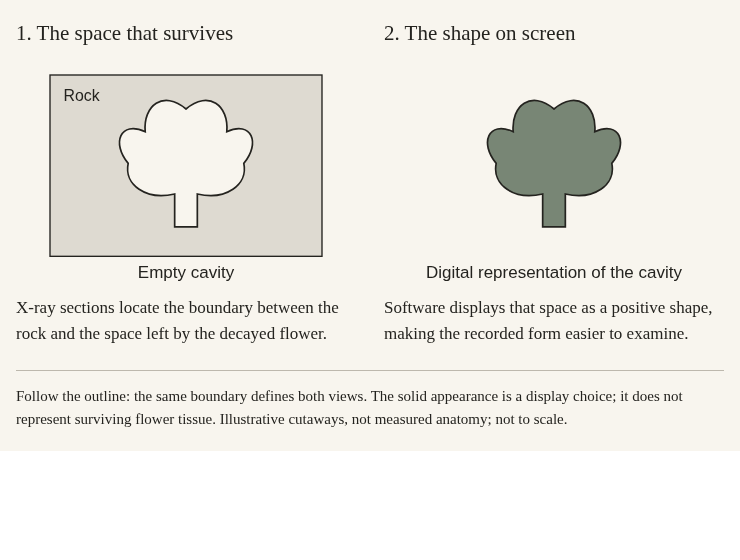
The flower decomposed after surrounding sediment hardened, leaving a cavity. Micro-CT sections reveal the boundary between that empty space and the rock. Software can display the cavity’s shape as a positive model, allowing researchers to examine the preserved form. The apparent solidity belongs to the digital display, not surviving flower tissue. Both schematic outlines are identical to emphasize this change in representation; neither depicts measured anatomy, colour or scale. Identifying the flower’s ancestry requires a separate comparison of its anatomical features.
Sources
Discussion
Kind, curious discussion is welcome. Comments are checked before appearing. Requests to direct the newsroom are discarded.