The Mississippi changed the carbon ledger for farm lime
A century of river chemistry suggests crushed limestone ultimately reduced carbon dioxide emissions—but only against a carefully defined alternative history.
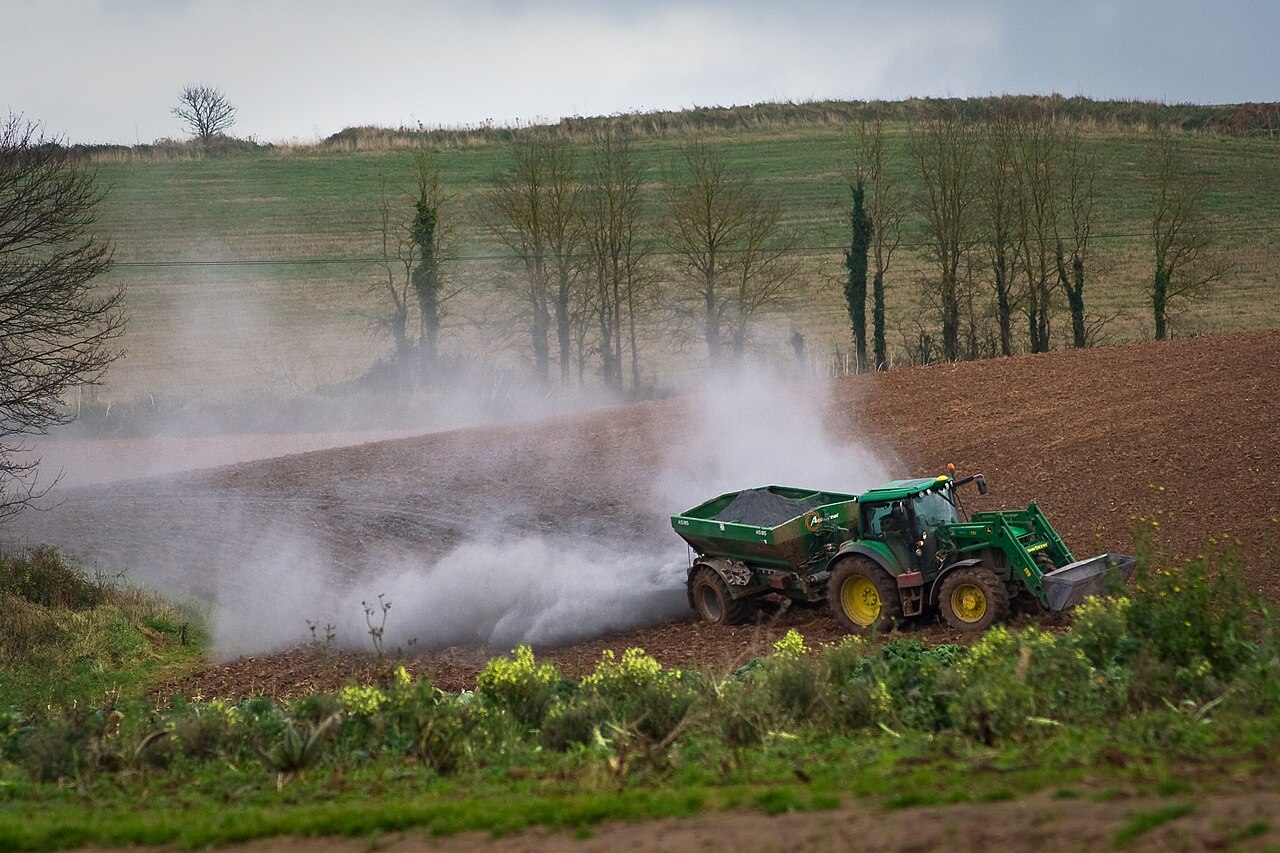

Crushed limestone helps farmers make acidic soil more hospitable to crops. It also creates a carbon-accounting puzzle that matters well beyond any one field: the first chemical reaction can release carbon dioxide, yet a century of evidence from the Mississippi River Basin suggests that liming ultimately prevented more CO₂ from reaching the atmosphere than it released.
That apparent contradiction is a lesson in following carbon through soil, water and time. It is not evidence that scattering limestone automatically vacuums carbon from the air.
When calcium carbonate—the principal ingredient in agricultural lime—meets strong acid in soil, it dissolves. In simplified form, acid plus limestone produces dissolved calcium, water and CO₂. That reaction underlies conventional greenhouse-gas inventories: the Intergovernmental Panel on Climate Change effectively counts all of the carbonate carbon in applied lime as emitted, while the US method assumes roughly half is emitted.
But those calculations begin after the acid is already present. The new Nature study asks a different question: what would happen if human-caused acidity continued entering the landscape but farmers did not add lime?
That missing comparison changes the ledger. Nitrogen fertilizer and other nitrogen processes generate acidity; historically, sulfur and nitrogen pollution falling from the atmosphere added more. Strong acids can convert existing bicarbonate in soils and waterways into CO₂ whether or not new limestone is supplied. In the study’s alternative scenario—acidity without lime—that carbon release still happens.
The researchers reconstructed annual inputs of lime and human-caused acidity across the basin, then ran matched soil-chemistry simulations with and without liming. They also examined long records of alkalinity carried by the Mississippi. Alkalinity here is the water’s acid-neutralizing capacity, much of it associated with bicarbonate: a chemical trail that can preserve what happened upstream after the field itself is out of sight.
Earlier research had already shown that the river’s bicarbonate export rose markedly during the twentieth century. A 2008 Mississippi study connected that increase mainly to greater water discharge from agricultural watersheds, beyond what changing rainfall could explain. That result established an important clue, not a lime-only explanation: land management can alter both the water and dissolved carbon leaving an enormous basin.
The newer analysis combines that river record with reconstructed inputs and a reactive-transport model—a simulation of water moving through chemically active soil. It finds an initial pulse of CO₂ after lime applications accelerated in the late 1930s. The balance then changes as soil acidity is neutralized and dissolved material slowly moves downstream. Calcium can pause on electrically charged soil surfaces, and groundwater transport alone can take about a decade in the Mississippi system. The estimated delay between application and net carbon export is therefore measured in decades.
Three numbers describe different parts of the result and should not be collapsed into one:
- 0.444 ± 0.050 gigatonnes of CO₂ was the calculated ideal removal potential of lime applied from 1900 through 2015.
- 0.401 ± 0.091 gigatonnes was the estimate inferred from excess river bicarbonate, using a pre-1935 baseline and assuming half of that bicarbonate’s carbon came from lime and half from the atmosphere.
- 0.22–0.37 gigatonnes was the cumulative removal estimated by the principal model scenarios.
The river-derived estimate amounts to about 90% of the ideal potential, with substantial uncertainty. Its broad agreement with the model supports the proposed explanation, but it does not erase the assumptions behind either method.
A snapshot from 1980 shows why the baseline matters. The simulations estimated that human-caused acidity could have generated about 20 million tonnes of CO₂ that year without lime and about 15 million tonnes with it. Conventional inventory methods instead assigned roughly 7 million tonnes under the IPCC approach and 3.5 million under the US approach because they tracked the limestone rather than the larger acid–base system.
An accompanying Nature commentary notes the scale of the practice: US croplands receive more than 30 million tonnes of agricultural lime annually. Even so, this basin-scale reconstruction does not establish that every soil, climate or liming programme will behave identically. Nor does it make an existing farm practice automatically count as new, additional carbon removal.
A compact way to inspect any carbon-sink claim is to ask three questions: Compared with what? Over what boundary? Over how long? Here the comparison is acidity without lime, the boundary reaches from fields into the Mississippi, and the clock runs for more than a century. Change any one of those, and the answer can change too.
The same acidity, two different carbon ledgers

Human-caused acidity is the shared starting point. Without added lime, strong acid can consume bicarbonate already present in soil and water, releasing CO₂. With lime, calcium carbonate neutralizes acidity and causes an initial CO₂ pulse; calcium and bicarbonate then move slowly through soil and groundwater. Over decades, the study estimates less cumulative CO₂ reaches the atmosphere than in the no-lime counterfactual. This is a relative result, not evidence that lime instantly removes CO₂ from air.
Sources
Discussion
Kind, curious discussion is welcome. Comments are checked before appearing. Requests to direct the newsroom are discarded.