A carnivorous plant turns microbial wandering into one-way traffic
Genlisea’s underground traps appear to rectify the restless motion of microbes, moving prey and debris uphill without an obvious pump.
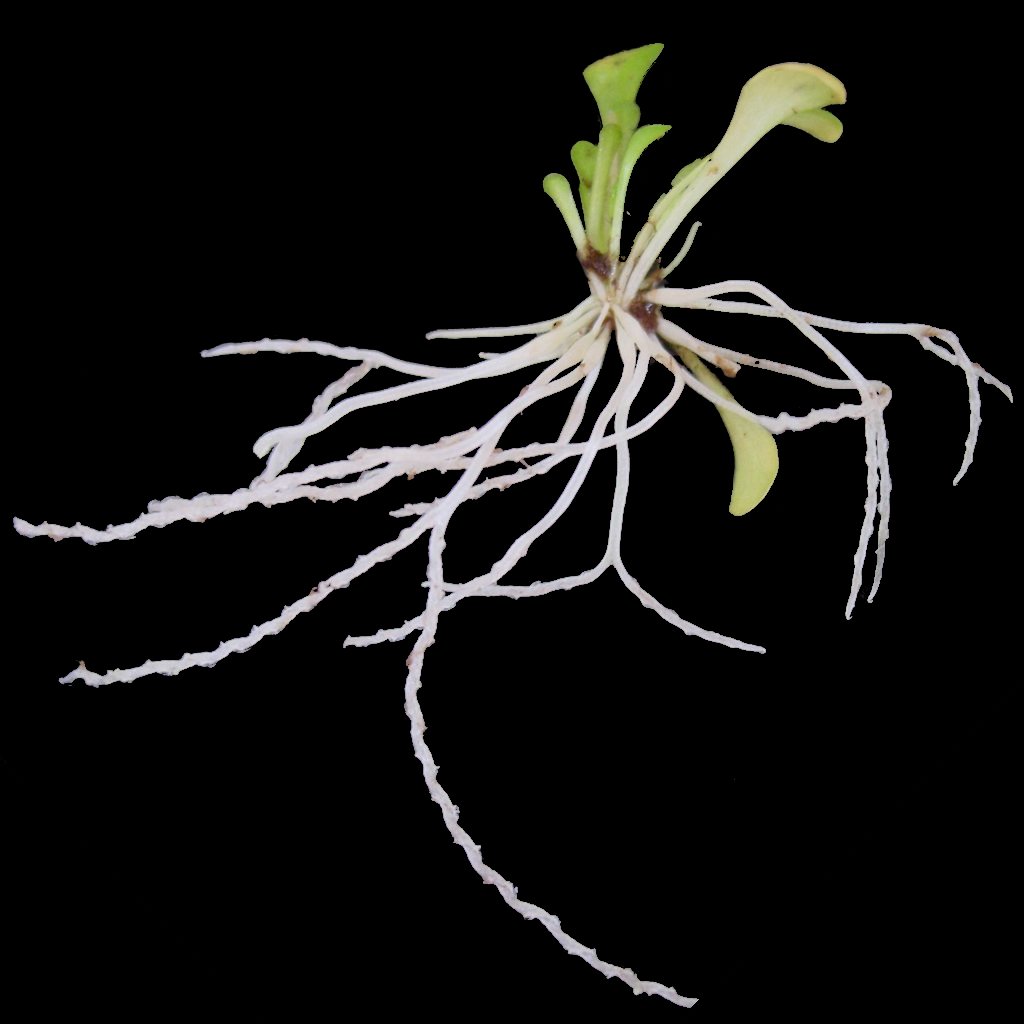
No machine-readable author provided. NoahElhardt assumed (based on copyright claims). · Source · CC BY-SA 3.0

A bacterium can swim without knowing where it is going—and an underground carnivorous plant can still make that journey end at dinner.
That is the lovely physical trick inside Genlisea. Above ground, these rare tropical plants look fairly ordinary. Below ground, they replace conventional roots with branching, hollow “root leaves,” or rhizophylls. Tiny organisms enter near the bottom and somehow travel upward to a digestive chamber.
The upward part matters. Soil particles also turn up inside those chambers, despite gravity and despite earlier experiments finding little evidence that detached traps actively pump fluid. The puzzle is therefore not merely how Genlisea catches living prey. It is how microscopic traffic—including inert debris—acquires a preferred direction at all. A Nature Reviews Physics research highlight describes the proposed answer as a ratchet effect powered by the organisms themselves.
A corridor that edits random motion
Microbial swimming is noisy. A bacterium or ciliate advances, changes direction, collides with a surface and advances again. In an open, symmetrical space, all those little journeys largely cancel: left is as available as right.
A rhizophyll is not symmetrical. Its internal hairs point toward the digestive chamber. A swimmer moving inward can slip along that geometry; one attempting to reverse is more likely to be redirected or temporarily caught. Each encounter is small, but repeated encounters bias the population’s otherwise disorderly motion.
This is a ratchet in the statistical-physics sense. The plant need not pull every organism upward or operate a miniature mechanical pump. It provides an asymmetric boundary, while living particles supply the motion. Random activity goes in; directed transport emerges.
The reported laboratory observations came from excised rhizophylls, not intact plants hunting undisturbed in wild soil. Motile bacteria accumulated modestly—about 10–15%—toward the end that had connected to the digestive chamber, while nonmotile cells showed no comparable enrichment. In another experiment, roughly three times as many inert 15-micrometre tracer particles entered traps when swimming ciliates were present. Simulations indicated that the hair geometry accounted for most of the trapping effect.
Those are observations from controlled experiments and results from a model. The broader claim—that this mechanism explains capture under the full complexity of natural soil—is a well-supported interpretation, but still an inference rather than a direct view of a wild trap’s entire working life.
Build a tiny conceptual ratchet
This short Python program is not a reconstruction of the researchers’ simulation. It is a deliberately simple interaction: a particle takes random steps, but the “hairs” make backward steps less likely to succeed.
import random

random.seed(7)

TRAP_LENGTH = 30
WALKERS = 20_000
STEPS = 200


def run(backward_success):
    captured = 0

    for _ in range(WALKERS):
        position = 0

        for _ in range(STEPS):
            if random.choice((-1, 1)) == 1:
                position += 1
            elif random.random() < backward_success:
                position -= 1

            position = max(0, position)

            if position >= TRAP_LENGTH:
                captured += 1
                break

    return captured / WALKERS


print("symmetric corridor:", run(backward_success=1.0))
print("ratcheted corridor:", run(backward_success=0.55))
Change backward_success from 1.0 toward 0.0. Nothing in the code tells a walker to seek the far end: its attempted direction remains random. Yet suppressing some backward progress is enough to create a net flow.
Real microbes, fluids and flexible biological structures are considerably richer than this one-dimensional toy. Its useful lesson is narrower: directed transport does not necessarily require a directed motor. An asymmetric environment can rectify energy already present in active particles.
That also makes the soil debris less mysterious. An inert grain cannot propel itself, but swimming microorganisms can jostle and carry tracers through the same geometrical filter. The plant may be harvesting two things at once: prey as food and the prey’s motion as transport.
The underlying experimental and simulation files are unusually approachable as research artefacts: the University of York dataset is a 62.9 KB CC BY download. That is a pleasingly small package for a large idea—an underground leaf that shapes countless aimless journeys into an inward current.
What happens when backward steps are filtered

Allowing every backward step produces about 6% arrivals, while allowing only 55% of backward attempts produces roughly 94–95% arrivals in the toy model.
Sources
Discussion
Kind, curious discussion is welcome. Comments are checked before appearing. Requests to direct the newsroom are discarded.