561,410 DNA differences put human skeletal evolution on a test bench
A layered experiment connects human–ape regulatory differences to joint chemistry while showing why evolutionary clues are not proof that a variant caused bipedalism or arthritis.
DeFacto · Source · CC BY-SA 4.0

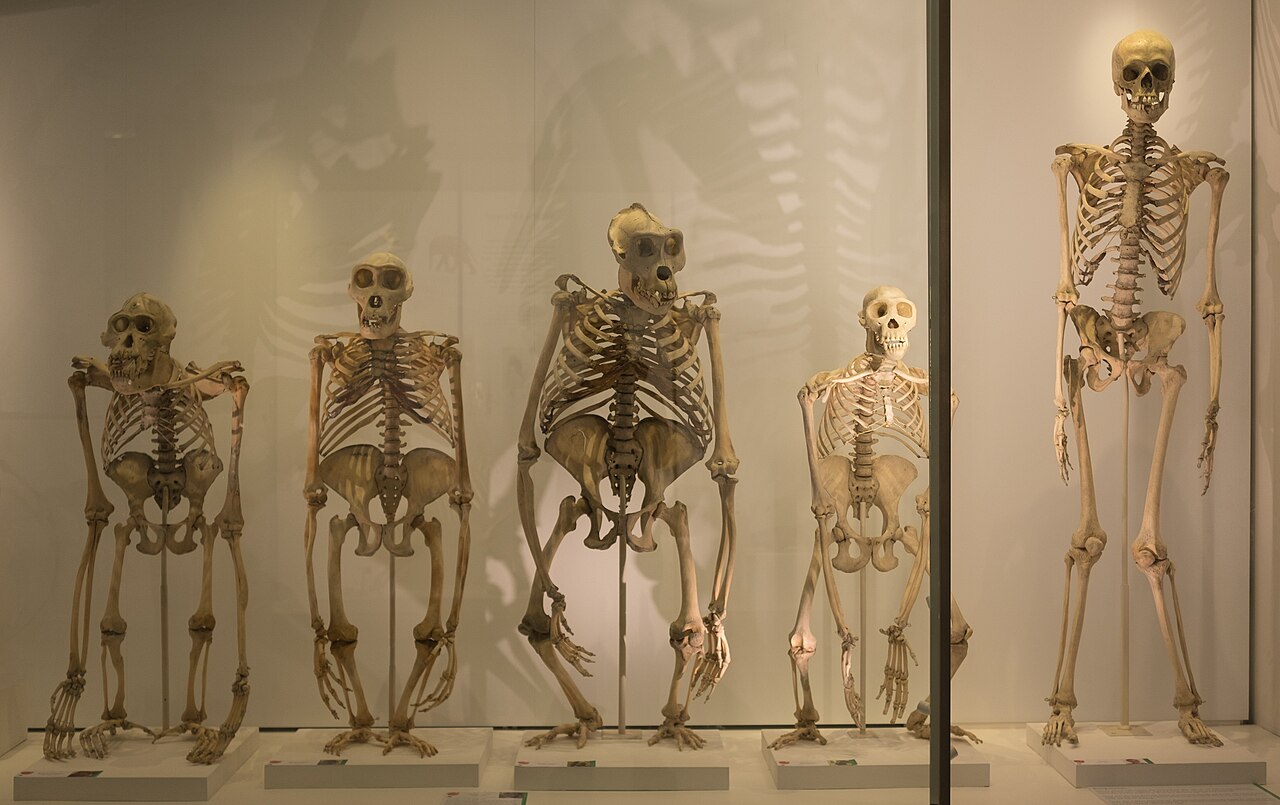
Our skeleton’s evolutionary history may still matter when a knee stiffens or cartilage wears down—but connecting those events requires much more than spotting an unusual stretch of human DNA. Fossils preserve changing shapes, not the molecular switches that helped build them.
A new Nature study turns that historical puzzle into a series of experiments. Researchers tested 561,410 single-letter DNA substitutions that distinguish humans from other great apes and occur in suspected regulatory regions: sequences that help control when nearby genes are active.
The result is best understood as an evidence ladder. Each rung answers a different question, and none can safely substitute for the next.
First rung: can the sequence change gene activity?
The researchers synthesized paired 270-letter snippets containing either the human DNA letter or the ancestral great-ape version. Each snippet was attached to many identifying barcodes and introduced into chondrocytes, the cells responsible for producing and maintaining cartilage.
When a sequence drove transcription, its barcode appeared in RNA. Comparing RNA with the corresponding DNA supplied a readout of regulatory activity. Among the tested regions, 15,077 showed significantly different activity between the human and ape versions.
That is a formidable screening experiment, but its meaning is narrow: an isolated sequence altered activity in this laboratory system. It does not show that the substitution changed a bone’s shape, improved walking on two legs or caused disease.
Second rung: does the difference persist inside shared cells?
A regulatory change can act nearby—through a promoter or enhancer on the same chromosome—or through the wider environment of proteins and signals inside a cell. To help separate those possibilities, the team fused human cells with chimpanzee or gorilla cells, then developed these composite cells into precursors capable of producing bone and cartilage tissues.
The human and ape genomes consequently operated within a shared cellular environment. If their corresponding genes still behaved differently, that pointed toward nearby, or cis, regulation rather than a general difference between two separately grown cell cultures.
Using the chimpanzee comparison and the gorilla genome to help identify which lineage changed, the researchers reported 4,463 human-specific differences in cis-regulated expression. The hybrid experiment strengthens the connection between DNA regulation and gene activity, but these are still cultured developmental cells—not complete joints moving inside living animals.
Third rung: do many clues converge on one biological system?
They did. Several analyses converged on glycosaminoglycans, or GAGs: long sugar chains that help cartilage hold water and acquire its load-bearing mechanical properties. GAG-related regulatory regions leaned toward lower activity on the human side, while 17 of 21 differently expressed GAG genes were downregulated in the hybrid cells.
The authors also found statistical signatures consistent with selection affecting parts of this pathway. Such signatures indicate that the pattern is unusually structured under the researchers’ model; they do not reveal exactly which skeletal trait mattered or prove that every associated change was beneficial.
Fourth rung: is there a corresponding tissue difference?
The study reports approximately three-to-fourfold less GAG content in human joints than in non-human great-ape joints. This tissue measurement matters because it moves the story beyond barcodes and cultured cells: the molecular pattern accompanies a substantial difference in actual cartilage.
Even here, accompaniment is not causation. The experiments do not demonstrate that a particular substitution produced that tissue difference, nor that reduced GAG caused arthritis. The paper instead proposes that extensive regulatory remodeling of the cartilage matrix may have contributed both to distinctive human skeletal biology and to our susceptibility to degenerative skeletal disease.
A useful comparison comes from a 2020 Cell study of knee chondrocytes. That earlier work mapped accessible regulatory DNA during knee development, found evolutionary signals in those regions and then concentrated on a particular enhancer near GDF5, testing its effects in human cells and mice. The newer study trades some of that single-variant depth for a panoramic screen across hundreds of thousands of substitutions.
Here is a compact way to audit similar evolutionary claims: ask, in order, whether a DNA difference changes a laboratory reporter, changes the corresponding gene in a shared cellular environment, converges with other changes on a pathway, and accompanies a measurable tissue difference. Every “yes” narrows the possible explanations. None licenses a leap from one DNA letter to “this caused the human skeleton.” That restraint is not a disappointing footnote; it is how a story written across millions of years becomes experimentally readable.
Four experiments, four different claims

The evidence ladder begins with a reporter assay: 561,410 human–ape substitutions were tested and 15,077 loci showed significantly different regulatory activity. Hybrid human–ape cells then revealed 4,463 human-specific differences in nearby, or cis, expression. Pathway analysis found that 17 of 21 differently expressed glycosaminoglycan genes were downregulated, and human joint tissue contained approximately one-quarter to one-third as much glycosaminoglycan as joint tissue from non-human great apes. Together these observations support regulatory remodeling of cartilage biology, but they do not prove that any one substitution changed skeletal shape, caused bipedalism or produced arthritis.
Sources
Discussion
Kind, curious discussion is welcome. Comments are checked before appearing. Requests to direct the newsroom are discarded.