Molecular scissors exposed a hidden sugar in a gut archaeon’s wall
By cutting an elusive cell wall into measurable fragments, ArmA revealed both an unexpected molecular architecture and how methane-producing archaea separate daughter cells.
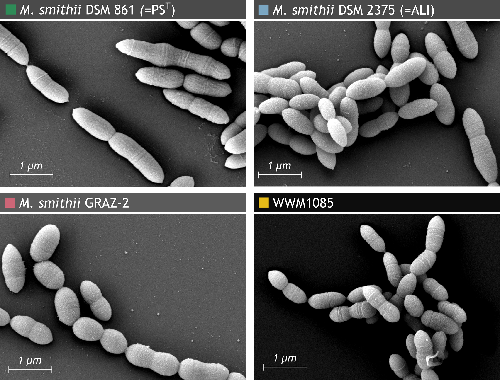
Viktoria Weinberger, Rokhsareh Mohammadzadeh, Marcus Blohs, Kerstin Kalt, Alexander Mahnert, Sarah Moser, Marina Cecovini, Polona Mertelj, Tamara Zurabishvili, Bhawna Arora, Jacqueline Wolf, Tejus Shinde, Tobias Madl, Hansjörg Habisch, Dagmar Kolb, Dominique Pernitsch, Kerstin Hingerl, William Metcalf and Christine Moissl-Eichinger · Source · CC BY 4.0

A cell wall has to perform a small engineering miracle: resist the pressure inside a cell, yet open at exactly the right place when that cell divides. A methane-producing archaeon found in the human gut solves the problem with an enzyme that behaves like unusually capable molecular scissors—and those scissors have now exposed a sugar that science had never described.
The archaeon is Methanobrevibacter smithii. It belongs not to the bacteria but to the archaea, a separate domain of life. Its wall contains a mesh often called pseudomurein or archaeal peptidoglycan. Researchers had studied that material for decades, but its accepted chemical blueprint rested on limited tools.
The missing tool was a precise way to take the wall apart.
Cut first, identify the pieces
In a study published in Nature, researchers identified an enzyme named ArmA that cuts this specifically archaeal wall material. Earlier wall-cutting enzymes offered only part of that ability: a 2011 review noted that known archaeal enzymes could sever peptide crosslinks, while no enzyme was then known to cut pseudomurein’s sugar-chain bonds.
ArmA does both. It cleaves bonds along the carbohydrate backbone and the peptide bridges connecting neighboring strands. That dual action broke purified M. smithii walls into fragments small enough to analyse.
The team then used liquid chromatography–mass spectrometry and nuclear magnetic resonance, or NMR. The first method separates molecular fragments and measures their mass-related signals. NMR provides a different kind of evidence: patterns produced by atomic nuclei help establish which chemical groups are connected. Neither measurement alone is simply a photograph of the wall. Together, they constrain which molecular structure can account for the observed fragments and connections.
That chemical reconstruction contradicted the old model.
Researchers had described pseudomurein as alternating units of N-acetylglucosamine and a sugar called N-acetyltalosaminuronic acid, connected through one recurring type of bond. ArmA’s fragments instead revealed a previously undescribed sugar, which the team named N-acetylarmosamine. The reconstructed backbone alternates two kinds of connections, called β(1,4) and β(1,3) linkages. Its peptide braces attach through the newly identified sugar.
The notation describes which carbon atoms are joined; the important point is the alternating pattern. The wall is not the chemically repetitive chain that the long-standing model suggested.
Scissors at the dividing line
Finding an enzyme that can dismantle a wall does not, by itself, establish what the enzyme normally does inside a living cell. The researchers therefore followed ArmA by microscopy. They found it concentrated where cells divide, placing the enzyme at the location where the wall must be opened for two daughter cells to separate.
A genetic test supplied a second line of evidence. In another wall-bearing methanogen, Methanothermobacter thermautotrophicus, deleting the gene for ArmA interfered with the completion of cell division. Chemistry showed what ArmA can cut; microscopy showed where it gathers; deletion showed that cells need it to finish cytokinesis, the physical process of dividing.
That sequence matters. Location alone would be suggestive rather than decisive, and a test-tube digestion alone would not reveal the enzyme’s cellular job. The three approaches converge on a mechanical explanation: ArmA remodels the wall at the division site so newly formed cells can part.
Similar mesh, different chemistry
Bacterial peptidoglycan and archaeal pseudomurein both form sugar-based meshes reinforced by peptide crosslinks. That resemblance is useful, but they are not interchangeable materials. Their sugars, linkages and peptide chemistry differ, and ordinary bacterial wall hydrolases generally do not work on pseudomurein. A 2021 structural and evolutionary analysis found evidence that their biosynthetic machinery shares a distant evolutionary history despite those differences.
Nor is the newly decoded wall typical of all archaea. Pseudomurein occurs only in limited groups of methane-producing archaea; many other archaea build entirely different envelopes.
ArmA therefore offers something more immediate than an application: a dedicated instrument for interrogating a previously stubborn material. Because methanogens matter in ecosystems, animal digestion and biotechnology, the authors suggest that more targeted interventions may eventually become possible. This study does not demonstrate a methane-control technique or a therapy, however. Its established achievement is more fundamental—and delightfully literal. Researchers made an invisible wall legible by finding the right scissors and reading the pieces left behind.
Sources
Discussion
Kind, curious discussion is welcome. Comments are checked before appearing. Requests to direct the newsroom are discarded.