CRISPR cut this virus’s DNA. Two proteins helped repair it
The phage system called Healer reveals a distinct counter-CRISPR strategy: surviving DNA damage after the molecular scissors have done their work.
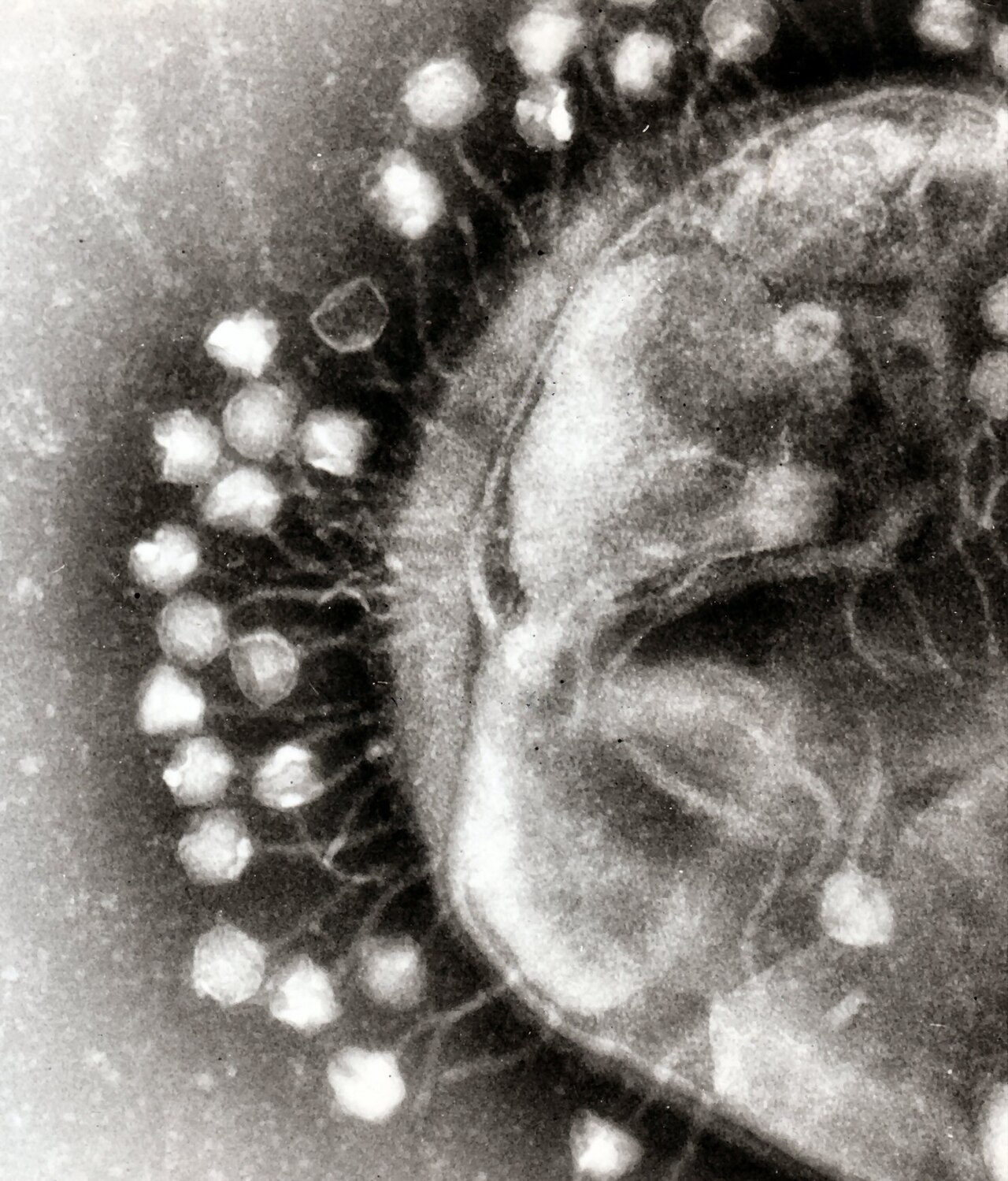
Professor Graham Beards · Source · CC BY-SA 3.0

CRISPR is famous as a programmable pair of genetic scissors. A new study adds an important consequence for anyone trying to understand—or use—those scissors: making the right cut does not decide what happens next. DNA repair can change the outcome.
In a peer-reviewed accepted paper released on September 21, researchers describe a two-protein system carried by bacteriophages, the viruses that infect bacteria. They call it Healer. According to the authors’ model, Healer does not prevent CRISPR from attacking the viral genome. It acts after the damage, helping the phage repair its DNA and remain viable.
That distinction turns a familiar molecular contest inside out. Instead of hiding the target or disabling the blade, the virus appears to survive the wound.
Two ways to escape the scissors
Bacteria use CRISPR systems as immune defenses against invading genetic material. Earlier research established that phages can carry anti-CRISPR proteins that interfere directly with different stages of this defense.
In biochemical experiments reported in 2015, two such proteins—AcrF1 and AcrF2—prevented a CRISPR surveillance complex from binding its DNA target. Another, AcrF3, allowed target recognition but prevented recruitment of Cas3, the component responsible for destroying the DNA. These are different molecular maneuvers, but they share a general strategy: obstruct the attack before the genome is successfully degraded. The experiments distinguished these mechanisms by testing which CRISPR component each protein bound and which step stopped working.
Healer represents a different category in the new study. Its two components are Gp63, which contains a region known as DUF669, and Gp64, a protein with an energy-using AAA domain. The authors report that Gp63 binds single-stranded DNA—the exposed form that can occur around a DNA break—and promotes Gp64-mediated homologous recombination. That is a repair process in which matching DNA sequences help reconstruct damaged genetic material.
The proposed sequence is therefore:
- CRISPR produces a break in the phage genome.
- Gp63 binds exposed single-stranded DNA.
- Gp63 promotes repair by Gp64 through homologous recombination.
- Repair of the CRISPR-generated break supports phage survival.
These steps are the study authors’ mechanistic interpretation, not separate claims independently established by the abstract available with the early article. What the paper reports overall is a two-protein, post-cleavage repair system that neutralizes CRISPR immunity by fixing phage DNA after it has been cut. The study describes Gp63 as a rapid-response component and links its DNA binding to Gp64-mediated repair.
What “matching DNA” contributes
Homologous recombination can sound more mysterious than it is. “Homologous” here means that two DNA molecules contain corresponding sequences. Proteins can bring complementary single strands together so their bases pair, creating an intermediate from which intact DNA can be restored.
A useful comparison is Redβ, a well-studied phage protein that helps complementary single DNA strands pair. Cryogenic electron microscopy—a method that reconstructs molecular structures from images of rapidly frozen samples—has shown Redβ molecules forming a helical assembly around two complementary DNA strands. A continuous groove positions the strands for base pairing. That structure provides a physical picture of how an annealing protein can organize matching DNA.
Redβ is context, not a molecular stand-in for Healer. The cited Healer study does not establish that Gp63 and Gp64 reproduce every step or structure of the λ-Red system. The comparison supports only the broader idea that arranging complementary single strands is a workable route into recombination-based repair.
From viral defense to laboratory editing
The researchers also paired Healer with the widely used CRISPR nucleases Cas9 and Cas12. They report that co-expression produced high phage genome-editing efficiency in laboratory systems involving Escherichia coli, Pseudomonas aeruginosa and Acinetobacter baumannii.
The logic is appealing: CRISPR supplies a targeted break, while Healer supplies machinery associated with repairing that break through homologous recombination. But the available verified evidence does not justify a universal efficiency claim or a comparison declaring Healer superior to established recombination tools. The reported result belongs to bacterial–phage laboratory systems, not clinical therapy.
There is also a relevant competing interest. Authors Yingfei Ma and Heng Zhu are named as inventors on granted patent CN202511305026.1, filed by the Shenzhen Institutes of Advanced Technology, Chinese Academy of Sciences, covering applications of the Healer system in genome editing.
The central finding is narrower—and more interesting—than the idea that CRISPR simply failed. In the authors’ account, CRISPR made the damaging cut. The phage’s countermeasure began afterward. For genome editing as well as microbial survival, the scissors are only half the story; the fate of the cut DNA depends on who arrives to repair it.
Where conventional anti-CRISPRs and Healer intervene

Conventional anti-CRISPR proteins stop an attack before destructive cleavage: AcrF1 and AcrF2 prevent target-DNA binding, while AcrF3 prevents Cas3 recruitment. In the Healer authors’ model, CRISPR first cuts the phage genome; Gp63 then binds exposed single-stranded DNA and promotes Gp64-mediated homologous recombination, supporting repair and phage survival.
Sources
Discussion
Kind, curious discussion is welcome. Comments are checked before appearing. Requests to direct the newsroom are discarded.