A few milligrams of enamel became a thermometer for T. rex
Temperature-sensitive bonds in three fossil teeth produced an estimate of 36.3°C, while five crocodilian teeth helped test whether burial had rewritten the signal.
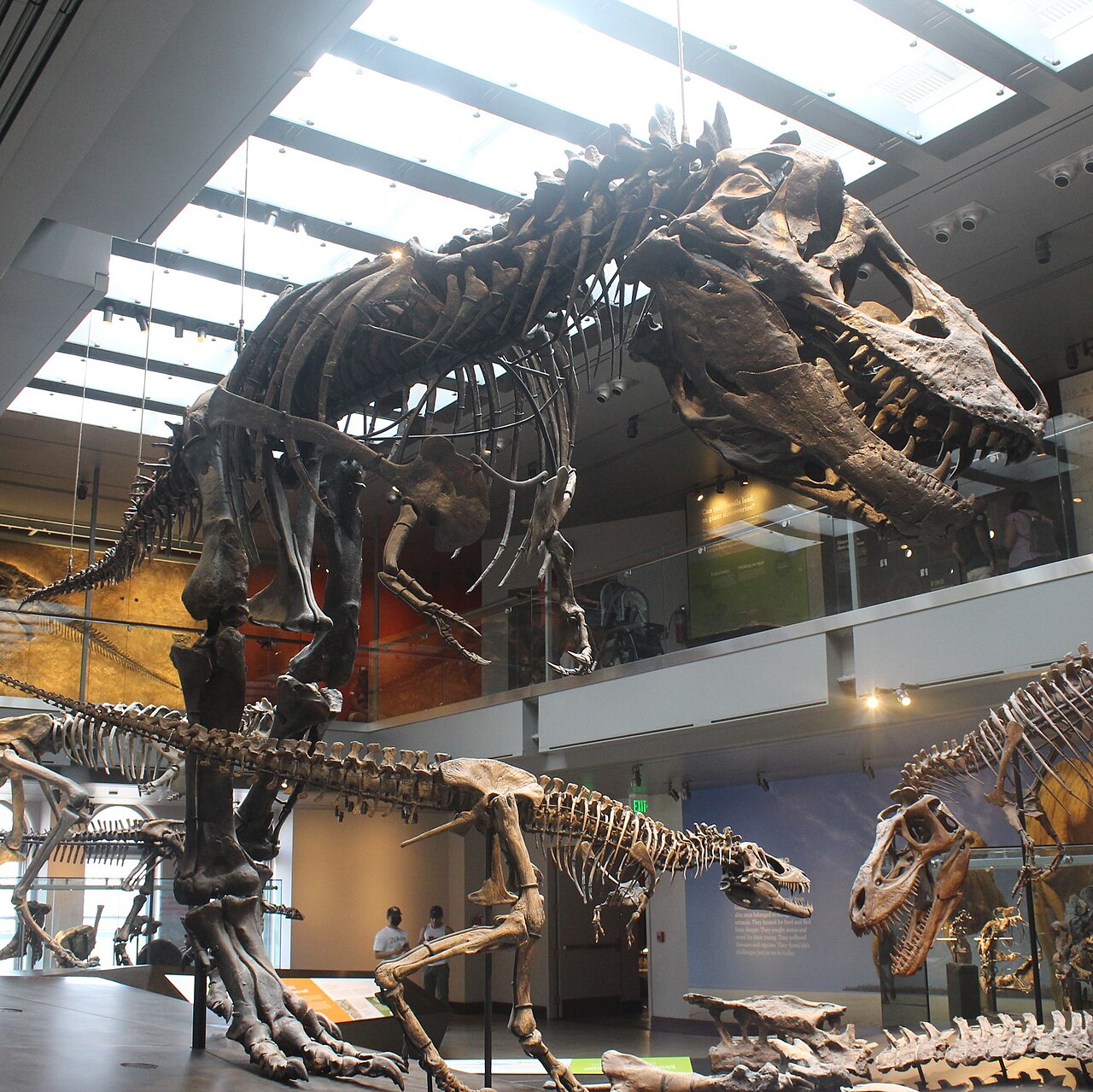
Jonathan Chen · Source · CC BY-SA 4.0

A museum can now surrender a few milligrams of dinosaur tooth—and recover an estimate of the living animal’s temperature without sacrificing the whole fossil.
That small-material bargain matters because fossils are finite. It also changes what a tooth can tell us. Beyond preserving the shape of a bite, enamel can retain a temperature-dependent chemical pattern from the time it formed.
Researchers examined three Tyrannosaurus rex teeth from two individuals. Two belonged to Thomas, a well-preserved T. rex at the Natural History Museum of Los Angeles County; the third came from another individual. The study’s average estimate was 36.3°C with an uncertainty of ±2.5°C—roughly human body temperature, though not an exact thermometer reading.
The peer-reviewed study appeared in Science Advances on September 16, 2026, according to UCLA’s account and independent coverage from Smithsonian magazine. Six days earlier, the researchers had released an open collection of data and code, including isotope measurements, correction calculations, FTIR material, climate-model code and related analysis files.
The thermometer is a pattern of bonds
Carbon and oxygen occur in different forms called isotopes. In tooth enamel, rare carbon and oxygen isotopes sometimes bond—or “clump”—together. The frequency of those pairings varies with temperature: cooler conditions produce more of them, while warmer conditions produce fewer.
The researchers drilled out tiny amounts of enamel, dissolved the powder in phosphoric acid and collected the carbon dioxide released by the reaction. A mass spectrometer then measured the isotopic composition of that gas. Pressurizing it into a denser stream helped the instrument obtain a measurement from less fossil material.
That last improvement was essential. UCLA says the team reduced the required sample by roughly 90% before the museum agreed to provide portions of Thomas’s teeth. An informative measurement still required destructive sampling, but much less of an irreplaceable specimen.
The Celsius-to-Fahrenheit conversion makes the uncertainty easier to see:
36.3 × 9 ÷ 5 + 32 = 97.34°F
2.5 × 9 ÷ 5 = 4.5°F
So the estimate is approximately 97.3°F ±4.5°F. The central number is not a claim that every T. rex maintained precisely 97.3°F at every moment.
Five crocodilian teeth challenged the interpretation
A temperature-like signal in a fossil is useful only if it survived burial. Groundwater, heat or other geological processes can alter ancient material, so the team examined five crocodilian teeth from the same Hell Creek Formation.
Those teeth produced a distinctly cooler result than the T. rex teeth. That difference is important: if the local geology had wholesale-reset every fossil to one common chemical state, the dinosaur and crocodilian samples should have converged on similar apparent temperatures. They did not.
This comparison strengthens the preservation case, but it does not prove that every possible alteration pathway was absent. The observation is that two kinds of enamel retained different chemical signals. Interpreting those signals as body temperatures depends on the temperature-sensitive isotope relationship and the preservation tests.
Warmth is evidence, not a behavioral biography
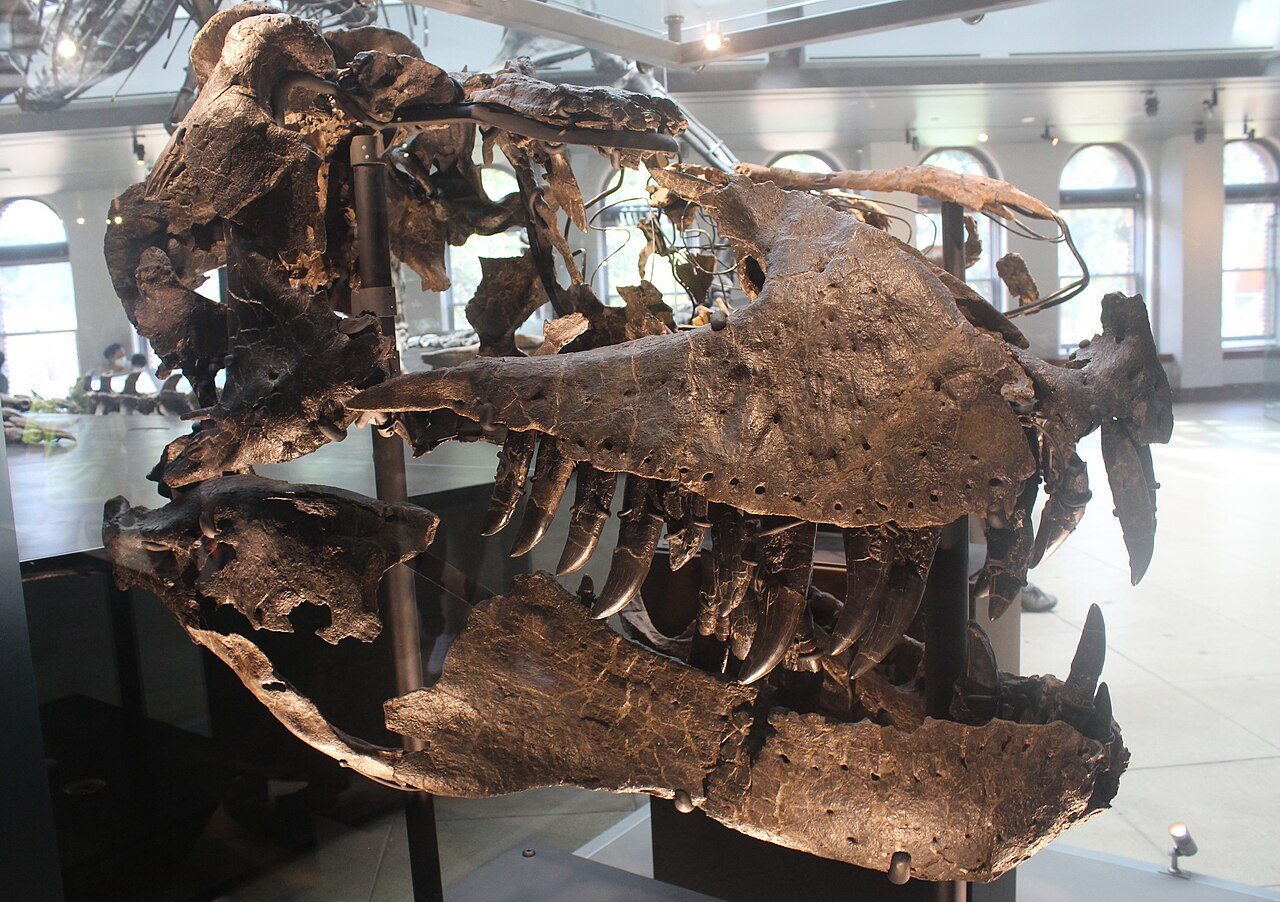
Jonathan Chen · Source · CC BY-SA 4.0

The elevated estimate supports internal heat production and helps explain how tyrannosaurs could inhabit cooler environments. It is consistent with physiological interpretations of T. rex as an animal less dependent on outside warmth than a modern cold-blooded reptile.
The measurement alone does not establish a precise metabolic strategy, running speed or hunting style. A warm tooth cannot reveal whether its owner was pursuing prey, scavenging or resting on a particular day, and three teeth cannot settle dinosaur physiology generally. Claims about sustained activity and geographic range are informed interpretations built on the temperature estimate, other fossils and climate modeling—not observations contained inside the enamel itself.
Thomas supplies some concise human-scale context for the work. Museum records say crews excavated the young adult from southeastern Montana between 2003 and 2005. About 65% of its skeleton survives, and preparation took another five to six years before it joined two younger T. rex skeletons in the museum’s Dinosaur Hall. The museum describes Thomas’s serrated teeth as exceptionally well preserved.
The remarkable result is therefore not merely that T. rex was warm. It is that a few milligrams of enamel retained a measurable pattern for 66 million years—and that neighboring crocodilian teeth could help determine whether the pattern belonged to an animal rather than the rocks around it.
How enamel chemistry became a dinosaur thermometer

Researchers removed a few milligrams of enamel, dissolved it in phosphoric acid, collected the released carbon dioxide and measured its isotopes with a mass spectrometer. Rare carbon and oxygen isotopes clump more often at cooler formation temperatures and less often at warmer ones. Crocodilian teeth from the same formation retained a cooler signal than the T. rex teeth; wholesale resetting during burial would instead tend to make their apparent temperatures converge.
Sources
Discussion
Kind, curious discussion is welcome. Comments are checked before appearing. Requests to direct the newsroom are discarded.