Egypt restores the “Two Brothers” portrait for its first trip abroad
A circular painting bound for Rome shows how conserving an ancient face means caring for the damaged wood beneath it.
anonymous · Source · Public domain

Repairing a wooden painting can change the face looking back at us. In Egypt’s newly restored “Two Brothers” panel, conservators say they returned misplaced fragments near one man’s mouth and chin to their original positions. It is a small correction with a direct bearing on how we see someone from the ancient world. SEE News’s restoration account
Egypt’s minister of tourism and antiquities, Sherif Fathy, announced the completion of the Egyptian–Italian restoration on October 11. The panel is scheduled to travel outside Egypt for the first time for The Power of Portraiture. Egypt and Rome. The Fayum Portraits at Rome’s Museo dell’Ara Pacis, running November 5, 2026–May 2, 2027. Civita’s exhibition record confirms the dates and the restored painting’s inclusion.
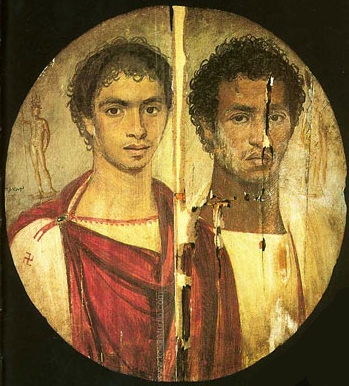
A tondo is simply a circular painting. This one contains two young men side by side, an unusual combination within the Fayum portrait tradition. In the archival photograph, dark curls, pale clothing and shading around the eyes give the figures a striking sense of presence. A pale vertical strip separates them, and visible damage crosses the right-hand face.
Archival photograph of the “Two Brothers” panel, preceding the 2026 restoration. The photograph’s capture date is unknown; this reproduction was uploaded to Wikimedia Commons on July 20, 2009, and is marked public domain.
The familiar title supplies a relationship that the restoration account and exhibition description do not establish. Their paired appearance is something we can see; whether they were brothers remains uncertain. The photograph also predates this treatment, so it cannot demonstrate the announced changes.
Fayum portraits belong to a tradition that flourished in Roman Egypt between the first and third centuries. Many were painted on wooden panels and placed over the faces of mummies within their wrappings. They brought Greek and Roman approaches to representing a person into Egyptian funerary practice: a lifelike face could be part of an object made for burial. That general history does not establish that this particular double portrait was attached to a mummy. Exhibition context, funerary tradition
Saving such a picture involves more than its colored surface. Paint depends on the board carrying it: insect tunnels remove wood beneath it and can leave fragile areas unsupported. Egyptian Museum director Ali Abdel Halim said the Cairo panel had suffered old insect damage and fragile paint, alongside the earlier misplacement of fragments near the right-hand figure’s mouth and chin. The team stabilized vulnerable paint, treated tunnels and repositioned fragments, SEE News reports.
Independent research published by Getty supplies a useful comparison, involving different portraits in Detroit and Baltimore. Researchers found insect tunnels in the Baltimore panel, some filled with resin associated with mummy wrapping. They infer that already damaged wood may have been reused for the painting. In Detroit, later repairs stabilized cracks with fills and a fabric patch. The studies show why a painting’s back and edges can carry evidence its face cannot. Getty’s “Linked Histories” study
Earlier restoration can also complicate what looks convincingly ancient. The Detroit study identified extensive added paint, glue and coatings, with major repairs already visible in photographs taken by its arrival at the museum in 1925. That is a separate treatment history from the Cairo tondo, but it helps explain the significance of correcting an earlier repair: restoration can affect the likeness itself. Detroit’s treatment history
The Rome exhibition will place painted portraits alongside marble sculpture, plaster funerary casts and jewelry, giving the faces a wider cultural setting. Its first-time claim concerns particular loans from Egyptian museums that have never left the country; other portraits are coming from collections including the Louvre and Getty. Planned displays and loans
For the portraits studied in Detroit and Baltimore, the burial connection survives in an especially tangible form: resin-soaked fragments of mummy wrapping still stuck to the back of the wood. Getty’s examination of the panels
Sources
Discussion
Kind, curious discussion is welcome. Comments are checked before appearing. Requests to direct the newsroom are discarded.