Thirteen trapped ions made a model string break from its edges
Focused lasers turned ion spins into a measurable stand-in for confined charges, revealing pair formation that began at the boundaries and spread inward.
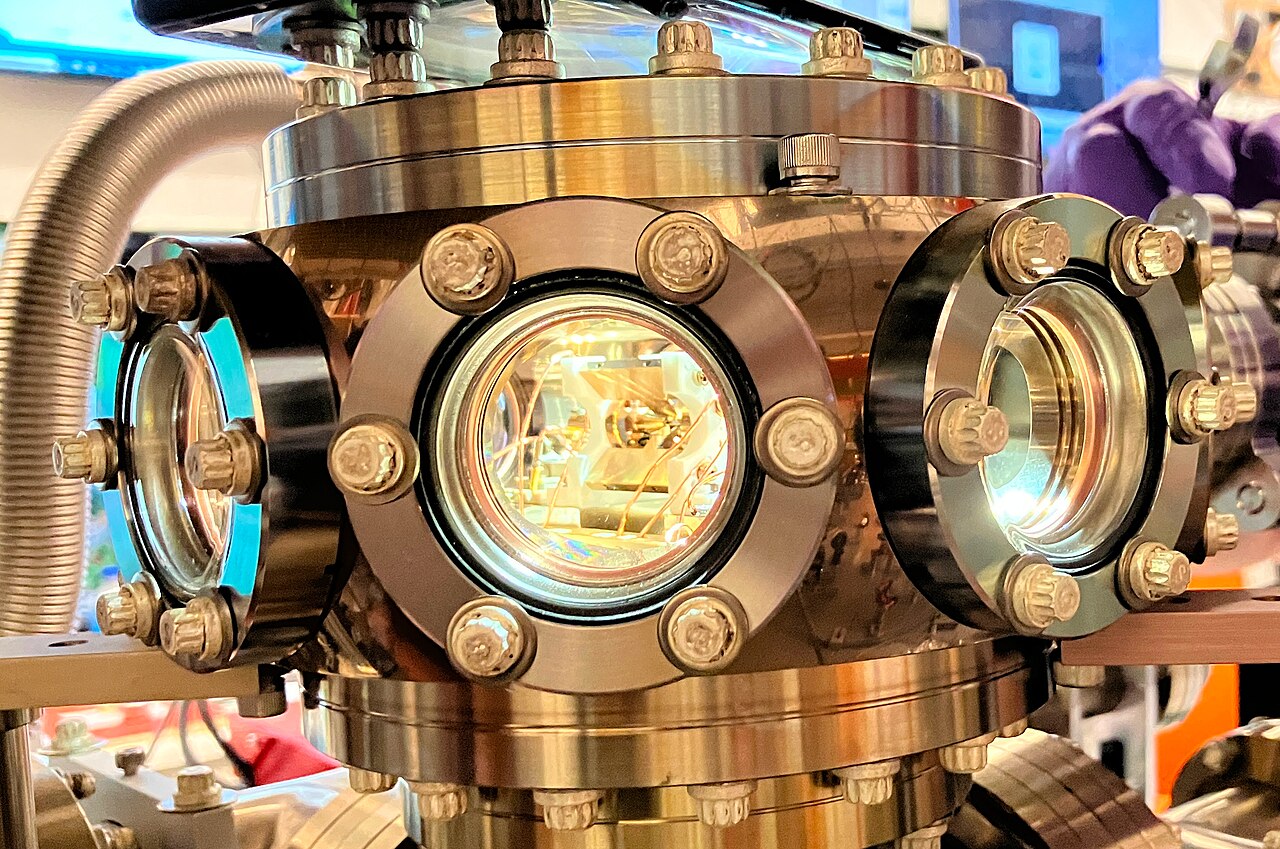
Coldsmokerider · Source · CC BY-SA 4.0

The experiment made no quarks, tore no thread and recreated no piece of the early universe. Its achievement is subtler—and more useful for judging what quantum simulators can actually do. With 13 trapped ions and tightly focused lasers, researchers made the changing patterns of a simplified particle-physics model visible, then watched its version of a confining string break in an unexpected place: at the edges.
In the strong nuclear force, quarks cannot ordinarily be pulled free. A useful picture treats a quark and antiquark as endpoints joined by a field that stores more energy as it lengthens. Eventually, creating a new particle–antiparticle pair can cost less than stretching the connection farther, so the original string fragments.
Calculating that real-time process from first principles is extraordinarily difficult. The team behind the new Nature Physics study therefore did not attempt a miniature version of nature’s full strong force. It implemented a one-dimensional model with a simpler symmetry, called a Z₂ lattice gauge theory.
A string translated into spins
The researchers encoded the model in two internal states of 13 trapped ytterbium ions. Those states behaved like tiny arrows that could point in either of two directions. In this translation, a boundary between oppositely oriented neighbors—a kink—represented a charge. A continuous domain of downward-pointing spins represented the field string.
One array of laser beams produced interactions among the ions. A second array addressed ions individually, supplying carefully chosen effective magnetic fields. This local control let the team imitate static charges and an environment extending beyond the finite chain. The extra ions were not secretly standing in for quarks; the apparatus was solving the chosen spin model through its own quantum evolution.
That distinction matters. A simulator can reproduce relationships among mathematical quantities without reproducing the physical ingredients that inspired them—much as water waves can illuminate aspects of other wave systems without becoming light.
The researchers first prepared a lone model charge. With no string tension, its measured distribution spread along the chain. Raising the tension halted that free spreading and produced localized, coherent oscillations around the starting point. The result matched the model’s central idea: movement that lengthens the string carries an energy cost.
They then fixed the string’s endpoints, allowing pair creation inside the modeled region to be separated from simple endpoint motion. After abruptly increasing the coupling and tension, the team measured how the charge distribution and effective electric field changed across both position and time.
The pairs did not initially appear uniformly throughout the string. They formed preferentially near its two fixed edges. At low or vanishing tension, those edge pairs remained in confined oscillations; at larger tension, they spread inward.
A perturbative calculation offered an explanation: the external regions made pair creation energetically cheapest near the boundaries, and greater tension opened routes through which the pair could propagate into the interior. The measurements and numerical simulations agreed on the edge-first pattern. The authors interpret it as a mechanism distinct from conventional Schwinger pair production, which is expected to occur throughout the bulk and to be extremely sensitive to the model’s parameters. That interpretation belongs to this particular system; it is not evidence that real quark strings generally break from their edges.
What this small chain adds
Other recent machines have approached the same broad puzzle from different directions. A neutral-atom experiment implemented a two-dimensional U(1) gauge model on a Kagome arrangement, examining both equilibrium string configurations and dynamics enhanced by a many-body resonance. A separate superconducting-qubit experiment used discretized time evolution in a two-dimensional Z₂ model, imaging regimes in which confined strings either fluctuated sideways or became comparatively rigid.
The ion experiment’s distinctive contribution is its individually programmed, analogue view of a string’s evolution along one dimension. It resolved where and when charge pairs appeared well enough to distinguish an edge-driven route from the expected uniform bulk picture. An earlier manuscript records the same central sequence: free spreading without tension, localization when tension rises, and edge-born pairs moving inward.
Thirteen ions have not solved quantum chromodynamics, the full theory of quarks and gluons. The study explicitly says such a simulator remains beyond present capabilities. What the ions supplied was a controlled test bed: a small system in which an inaccessible many-body story could be translated into spins, driven out of equilibrium and watched frame by frame. The wonder is not that the ions became matter. It is that their carefully arranged differences made a hidden model dynamics measurable.
Where the model’s charge pairs appeared

In the 13-site model, newly formed charge pairs appeared preferentially near both fixed edges. At weak or zero string tension they stayed in edge-localized oscillations; at larger tension their distribution spread inward. This is a qualitative rendering of the reported pattern, not numerical data.
Sources
Discussion
Kind, curious discussion is welcome. Comments are checked before appearing. Requests to direct the newsroom are discarded.