To read a burned scroll, scientists made one to sacrifice
A modern papyrus with known writing showed how lead-sensitive X-rays and virtual unrolling might identify ancient texts worth scanning—without touching their brittle layers.
Sara Stabile, Francesca Palermo, Inna Bukreeva, Daniela Mele, Vincenzo Formoso, Roberto Bartolino & Alessia Cedola · Source · CC BY 4.0

A sealed scroll can contain a lost book and still be safer left unread. The carbonized papyri of Herculaneum are so brittle that physically opening them can turn their pages into fragments. The useful question, then, is not simply how to see inside. It is how to prove that a reading method works when the original object is too precious to use for trial and error.
A research team found a delightfully direct answer: make a scroll whose secrets are already known, burn it, and try to recover them without unrolling it.
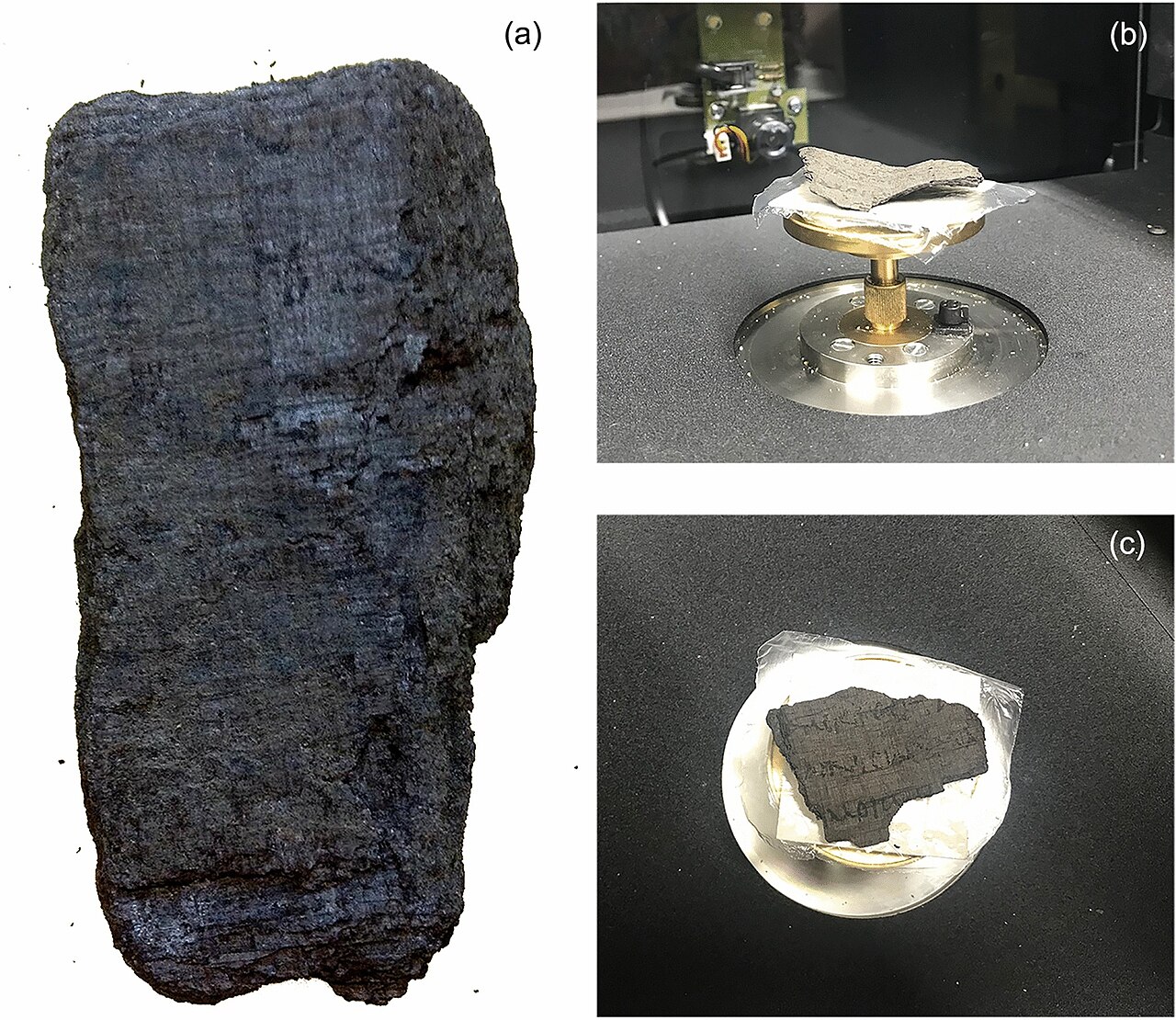
For a study published in PLOS ONE on September 16, 2026, the researchers wrote known passages on modern Egyptian papyrus, rolled the sheet, carbonized it in a low-oxygen container and scanned the resulting blackened cylinder. The replica became extremely brittle, much like the surviving scrolls from Herculaneum. Attempts to open it caused fragmentation.
That failure was part of the design. The model had to present the same basic problem as an ancient scroll: tightly packed, uneven layers that could not safely be pulled apart.
Black ink on black paper
Ordinary ancient ink was often made with carbon-rich soot. Carbonized papyrus is also carbon-rich. In an X-ray image, the writing and its background can therefore look frustratingly alike—the equivalent of trying to find charcoal marks on charcoal paper.
The team tested a possible escape from that problem by deliberately adding lead to the model ink. Lead blocks X-rays much more strongly than the surrounding charred papyrus, allowing inked marks to appear as bright features in a scan.
This was not an attempt to reproduce every detail of an ancient recipe. The lead was a controlled experimental marker. Its concentration could be varied, and the researchers knew exactly what had been written and where. That combination made the replica a piece of ground truth: data with a correct answer available for comparison.
Ground truth matters because a plausible-looking digital letter is not necessarily a real one. Software can mistake folds, cracks, fibers and scanning noise for ink. With a known-text model, researchers can ask sharper questions: Did the scan reveal the correct mark? Did the unrolling program put it in the correct place? Did an image-processing method recover writing or merely manufacture something letter-shaped?
Three tools, three different jobs
The proposed workflow separates the problem into stages.
First comes X-ray fluorescence, or XRF. When X-rays excite atoms in a material, different elements emit characteristic signals. A handheld XRF instrument detected lead in the carbonized model, suggesting that the same kind of device could serve as a preliminary screen for ancient scrolls. It would not read a hidden book. It would help identify scrolls whose ink chemistry makes them promising candidates for more elaborate imaging.
Next comes X-ray computed tomography, the same broad idea behind a medical CT scan. The model scroll was rotated through a full circle while the instrument collected 1,001 projections. Those views were reconstructed into a three-dimensional map. Where the ink contained lead, its marks contrasted with the carbonized papyrus around them.
The third step is virtual unrolling. A CT scan produces a tangled volume, not a convenient flat page. Software must trace the scroll’s curving layers and transform points along those surfaces into a flattened image. According to UC Berkeley’s account of the experiment, the program was adapted from software developed to follow the rolled internal layers—the “jelly rolls”—of lithium-ion batteries. A tool for inspecting modern energy storage turned out to have the right geometry for an ancient book.
The sequence is easy to picture:
XRF asks: Is lead present?
CT asks: Where are the lead-bearing marks inside the roll?
Virtual unrolling asks: What do those marks look like on a flat page?
On the replica, that chain recovered readable writing without physically separating the carbonized layers.
What the experiment actually demonstrated
The researchers detected writing containing 25 micrograms of lead per square centimeter with both XRF and X-ray imaging. That number needs careful handling: 25 micrograms was the lowest concentration they tested, not a measured lower limit for the instruments. The experiment therefore shows detection at that concentration. It does not establish that weaker signals would necessarily disappear.
Nor does it show that an authentic sealed Herculaneum scroll can now be placed under a scanner and read immediately.
Lead has previously been found in writing on some ancient papyrus material, including Herculaneum fragments, but the surviving rolled collection has not been systematically screened. Researchers do not yet know how many scrolls contain enough lead to provide this helpful contrast. The model’s ink was intentionally fortified; an ancient scribe’s ink may have contained much less lead, none at all or metals distributed in a different way.
The study also did not decode an authentic Herculaneum scroll using this complete workflow. Its result is narrower and, scientifically, more useful than a premature claim of success: it shows that a known-text carbonized model can connect elemental screening, three-dimensional imaging and virtual flattening in one testable system.
That distinction separates observation from inference. The observation is that lead-bearing writing in the replica remained detectable after carbonization and virtual unrolling. The inference is that ancient scrolls with sufficiently lead-rich ink could be easier to read by similar methods. Whether many such scrolls exist remains an open historical question.
A sacrificial object that protects the originals
The replica can be scanned repeatedly, made with different ink compositions and deliberately pushed until an algorithm fails. If it cracks, it can be replaced. An ancient scroll cannot.
That makes the burned model more than a theatrical stand-in. It turns an archaeological dilemma into an experiment with adjustable variables and known answers. Instead of refining software on irreplaceable manuscripts while hoping that faint patterns are letters, researchers can build increasingly difficult test scrolls and measure exactly where their methods succeed.
There is a pleasing reversal here. The original Herculaneum scrolls survived because heat transformed them into unreadable carbon. The replica was subjected to a similar transformation so that researchers could learn how to see through it. One scroll was burned on purpose so that others might never need to be opened.
Publication note: the peer-reviewed study and UC Berkeley report appeared on September 16, 2026. A syndicated Phys.org version was published September 18; that is the date of the later coverage, not of the study itself.
From sealed scroll to flat text: three tools, three jobs

The workflow has three distinct stages: X-ray fluorescence screens a sealed scroll for lead; computed tomography records 1,001 projections and maps lead-bearing marks within the rolled layers; virtual-unrolling software traces a curved papyrus layer and transforms it into a flat image. Writing containing 25 micrograms of lead per square centimeter was detected, but this was the lowest concentration tested—not an established detection limit.
Sources
Discussion
Kind, curious discussion is welcome. Comments are checked before appearing. Requests to direct the author and excluded topics are discarded.