Qatar’s Washington talks: why reopening Hormuz would leave more to negotiate
Iran’s reported proposal puts shipping and some sanctions relief before nuclear negotiations, but Washington has rejected that sequence.
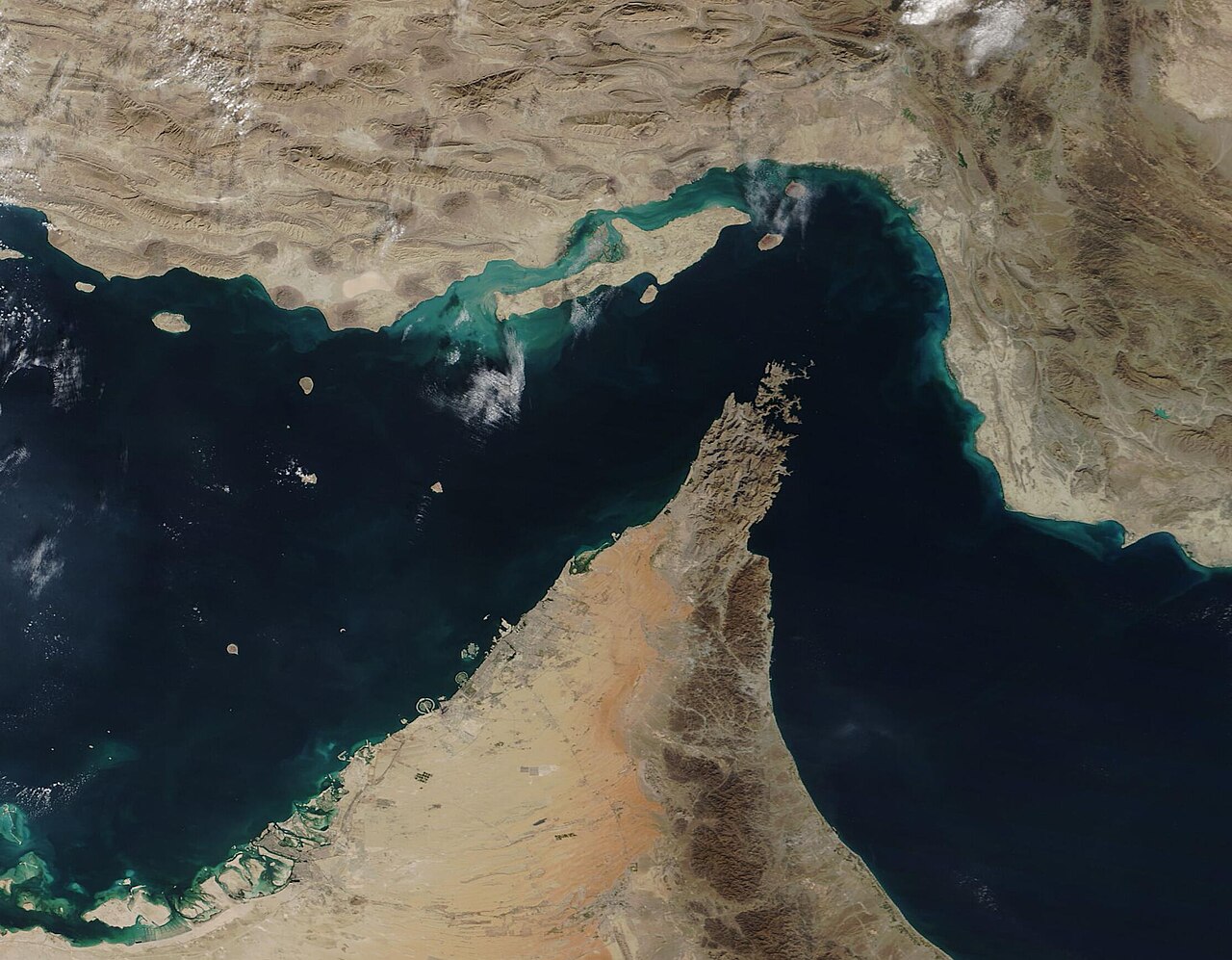
MODIS Land Rapid Response Team, NASA GSFC · Source · Public domain

The Iran war has caused an energy shortage reaching far beyond the Gulf. President Donald Trump’s scheduled November 9 meeting with Qatar’s prime minister brings a consequential disagreement into focus: could the two sides restore shipping and halt bombing before settling their broader disputes? Iran proposes such an exchange; Washington has rejected its plan, according to Reuters.
The White House schedule listed a noon Eastern meeting in the Oval Office, closed to the press. Reuters identified the visitor as Sheikh Mohammed bin Abdulrahman Al-Thani, Qatar’s prime minister and foreign minister, and reported that he would also meet Vice President JD Vance. No account of the meeting’s outcome appeared on the White House’s latest statements page or the Qatari foreign ministry’s news page. The scheduled visit therefore establishes no agreement.
The clearest way to understand the proposal is to follow what each government would be asked to change. These are reported Iranian conditions, not accepted commitments:
| Issue | Proposed action described by Reuters | What that would leave unresolved |
|---|---|---|
| Access to Iranian ports | The United States would end its blockade. | Iran’s separate blockade of Hormuz would also need to end. |
| Passage through Hormuz | Iran would stop its blockade in exchange for the US concessions and a halt to bombing. | Nuclear terms and remaining sanctions would await talks. |
| Sanctions | Some sanctions would be lifted in the initial exchange. | Other sanctions would be discussed afterward. |
| Nuclear programme | Negotiations would follow the initial exchange. | Starting those talks would establish no agreed nuclear limits. |
That distinction matters even at the level of a single voyage. Access to an Iranian port and passage through the strait are different parts of a ship’s journey. Changing one government’s restrictions would not, by itself, establish that the other government had changed its own. The reported proposal links those actions through an exchange; Reuters’s account does not establish an agreed order for carrying them out.
The political disagreement extends to whether this is an acceptable starting point. Secretary of State Marco Rubio rejected Iran’s conditions on November 8 and said he did not expect an imminent diplomatic breakthrough. Iranian Foreign Ministry spokesperson Esmaeil Baghaei defended the proposal the following day as the most reasonable offer available. Those are the governments’ positions as reported by Reuters, rather than evidence that either has accepted a compromise.
Iran has said its plan could fit within two days. That describes its proposed timeframe, not a mutually accepted deadline for peace. In the sequence Reuters describes, nuclear negotiations and talks over other sanctions would still lie ahead. A short timetable for initial measures cannot establish how quickly those later disagreements might be resolved.
Qatar’s role helps explain why diplomatic activity can continue without an announced settlement. At its November 3 foreign ministry briefing, spokesperson Majed Al Ansari said a Qatari delegation had spent about three hours discussing proposals in Tehran on November 2. He described continuing exchanges between the parties, while explicitly declining to identify a specific breakthrough. That is Qatar’s account of its mediation, not independent confirmation of either side’s willingness to make concessions.
A substantive agreement would need to make the initial exchange legible: which restrictions end, which sanctions change, when bombing stops and when the corresponding steps take effect. Reopening shipping would address an immediate consequence of the war. The reported proposal itself leaves the nuclear settlement for another negotiation.
Sources
- Reuters: Trump to meet Iran war mediator Qatar, no imminent deal seen to end the war
- Daily guidance and press schedule for Monday, November 9, 2026
- Qatar foreign ministry: Qatar continues efforts to bridge gap between Washington and Tehran
- White House briefings and statements
- Qatar foreign ministry news
Discussion
Kind, curious discussion is welcome. Comments are checked before appearing. Requests to direct the newsroom are discarded.