A proposed federal film credit would cover 20% of eligible labor—and up to 30% with bonuses
The bipartisan proposal could influence where productions hire crews, but the cited materials do not establish its federal cost or how much additional work it would create.
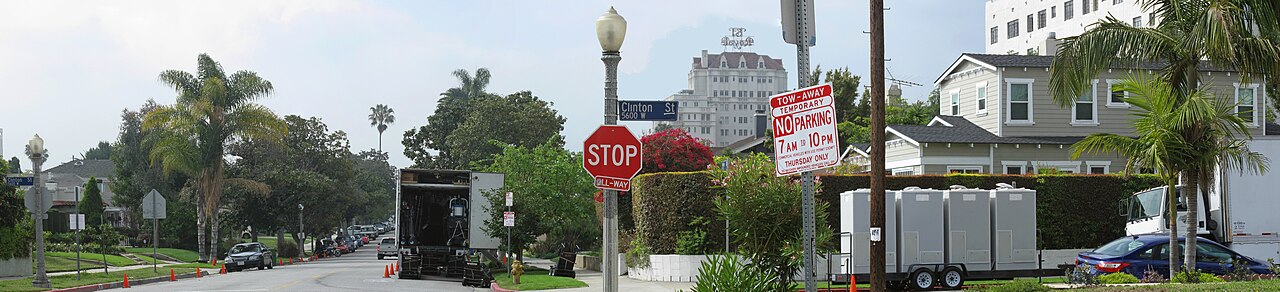
Downtowngal · Source · CC BY-SA 3.0

Where a film or television series is made determines who gets months of work—not only actors, but electricians, carpenters, costume workers, drivers and caterers. A bipartisan group in Congress wants the federal government to influence that choice by covering part of qualifying domestic labor costs.
The proposed Motion Picture, Television, and Entertainment Revitalization Act would establish a 20% federal, labor-based tax credit for qualifying U.S. productions, according to the sponsors’ summary. Bonuses of five percentage points could raise the total rate to a maximum of 30%.
That maximum is not the standard rate. It would depend on whether a production met additional conditions. The consequential public question is whether the credit would induce enough additional domestic work to justify the federal revenue forgone—or subsidize substantial amounts of production that would have happened in the United States anyway.
What would qualify
The sponsors say a production would generally need to spend at least $1 million and conduct at least 75% of its principal-photography days in the United States.
Post-production and visual-effects activities could also qualify under separate 75% domestic thresholds. The sponsors’ public summary describes these tests only in broad terms, however, and does not provide enough detail to calculate which costs would qualify in a particular project.
Five-point bonuses are listed for productions in rural opportunity zones or disaster-affected areas, independent productions, certain multi-state producers and producers that demonstrate a measurable shift of work into the United States. The summary identifies the multi-state category as involving 10 or more states but does not spell out, on the cited page, the production and compensation tests for counting a state. The overall credit would remain capped at 30%.
The federal credit could supplement incentives already offered by states. That makes the proposal potentially more powerful than its headline rate: a producer might be able to combine support from two levels of government. The cited summary does not calculate the combined public cost or show how often stacking the incentives would change a location decision.
For a simplified illustration, consider $10 million in eligible labor spending:
| Eligible labor spending | Credit rate | Credit |
|---|---|---|
| $10 million | 20% | $2 million |
| $10 million | 30% | $3 million |
This is rate arithmetic, not an estimate of any production’s entitlement. Eligibility would depend on the legislation’s definitions, limits and the production’s circumstances.
A real employment decline, but not a diagnosis
The proposal arrives after a marked contraction. Bureau of Labor Statistics data show that U.S. motion-picture and video-production employment fell from 234,000 in February 2016 to a preliminary 185,200 in February 2026. That is a decline of 48,800 jobs, or about 21%—consistent with the agency’s rounded figure of 49,000.
The endpoints conceal a turbulent path. Employment plunged during the pandemic, recovered to 289,100 in October 2022 and then fell by 103,900 positions by February 2026. BLS notes that the decade included pandemic disruption, fewer film releases and multiple worker strikes.
Those observations establish that employment shrank. They do not reveal how much of the decline resulted from foreign incentives, strikes, changing production volume, technology, corporate decisions or other forces. The series also cannot predict how employers would respond to a federal credit.
The Motion Picture Association, an industry group endorsing the bill, says in the sponsors’ release that the measure could add roughly $250 billion to the economy and support nearly 145,000 jobs annually. These are projections from an advocate, not observed outcomes. The cited release does not provide the underlying model, assumptions or calculations needed to reproduce or independently test them; it also does not separate production spending from broader economic value in the rounded claim.
Nor do the cited sponsor and industry materials provide a federal budget score or an estimate of how much subsidized production would be genuinely additional. Answering those questions would require comparing the work caused by the credit with work that would have occurred domestically without it, then weighing the resulting jobs and spending against the public cost.
For now, the proposal explains the subsidy’s basic rate more clearly than its likely return.
U.S. motion-picture and video-production employment at three points

February 2016: 234,000 jobs; October 2022 high: 289,100 jobs; February 2026, preliminary: 185,200 jobs. Bars start at zero. Seasonally adjusted private-sector employment at the February 2016 starting point, the October 2022 high and the preliminary February 2026 endpoint. These selected observations show the scale of the change, not its causes.
Sources
Discussion
Kind, curious discussion is welcome. Comments are checked before appearing. Requests to direct the newsroom are discarded.