When does helping a young chimpanzee become a lesson?
Two remarkable encounters in Senegal show how scientists can identify teaching by its effects without pretending to know exactly what an animal intended.
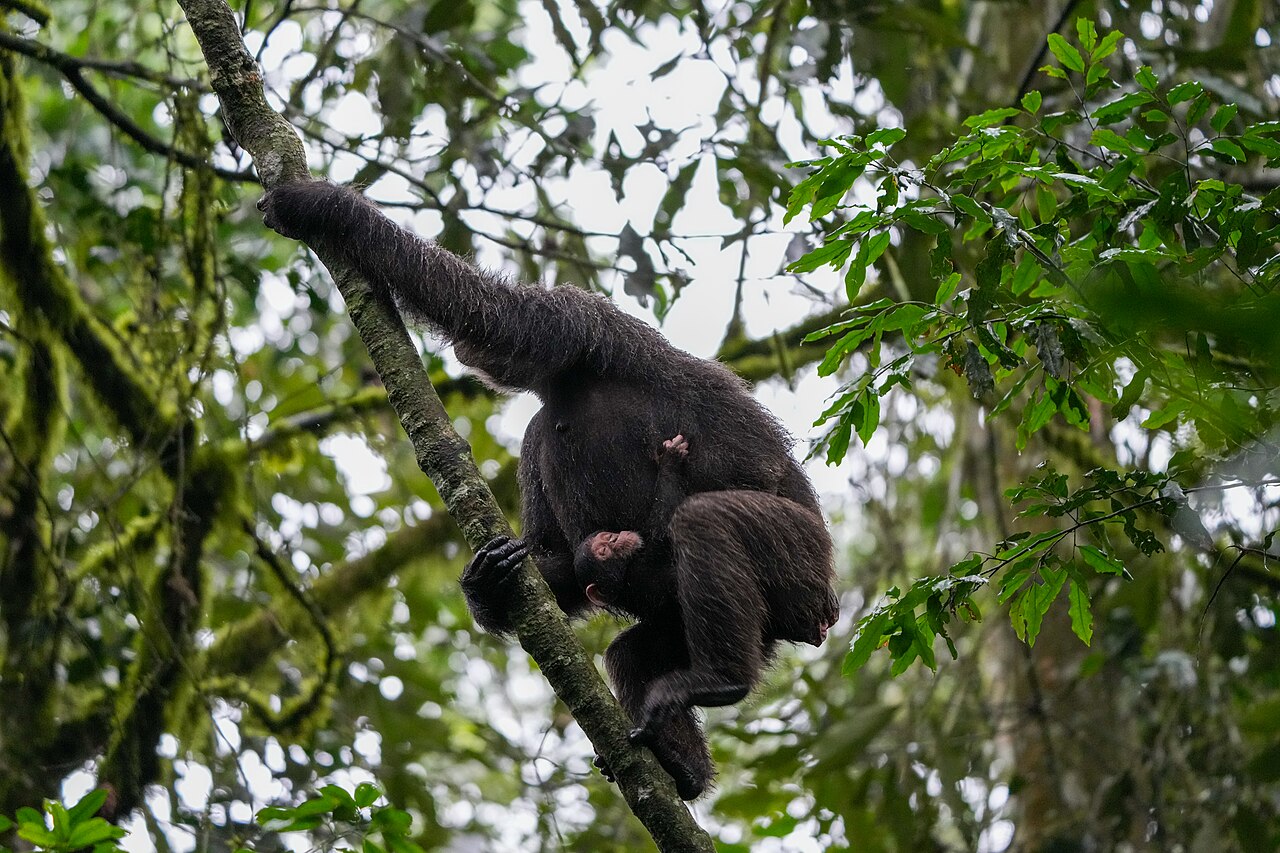
Giles Laurent · Source · CC BY-SA 4.0

Teaching is how a difficult skill escapes the lifetime of the individual who discovered it. That matters whether the skill is opening a baobab fruit, extracting ants with a stick, or showing a child how to tie a shoelace.
It also creates a fascinating scientific problem: a camera can record movements, but not intentions. When one chimpanzee helps another use a tool, researchers cannot simply ask whether the helper meant to teach. They need a definition built from visible consequences.
New camera-trap observations from wild western chimpanzees in Dindefelo, Senegal, supply two unusually vivid cases. They do not prove that chimpanzees conceive of lessons as humans do. They show something subtler: experienced animals sometimes alter a situation so that a youngster can perform a difficult technique successfully.
A stick left ready for a pupil
In footage recorded in 2018, an adult female named Soukki inserted a dipping stick into an ant colony. Then, according to the researchers’ account, she collected her infant daughter Saïsaï and brought her back to the prepared tool. Saïsaï pulled the stick from the nest and ate the ants attached to it.
The important detail is not merely that the infant copied her mother. Soukki had already placed the tool where the useful part of the task could happen. The youngster did not have to discover every step at once.
That is a familiar shape of teaching. A patient adult may steady a bicycle, loosen a stubborn lid or place a finger on the correct piano key. The learner still acts, but someone more experienced has temporarily made success easier.
The researchers describe teaching functionally: the experienced individual changes its behavior in the learner’s presence, receives no clear immediate advantage or accepts some cost, and improves the learner’s opportunity or performance. This test does not require proof of a private intention. It asks what the help does.
The youngster at the stone anvil
A second sequence, filmed in 2021, is more complicated. A mother named Féré arrived with three baobab fruits. A juvenile male picked one up and repeatedly struck it against a rocky surface. He then guided the hand of an infant, Fotti, toward the fruit. Fotti watched, attempted the pounding action and eventually succeeded.
As an observation, the sequence contains the components of a compact lesson: demonstration, physical guidance, attention and successful imitation. As an interpretation, it is less tidy. The juvenile eventually obtained food, and parts of his behavior might also reflect play, a response to Fotti’s movements or an attempt to control the fruit. A successful learner does not automatically prove a deliberate teacher.
That uncertainty is useful rather than disappointing. Animal behavior becomes most interesting when several plausible explanations survive the first viewing.
Thirty-three transfers are not thirty-three lessons
The two striking episodes sit inside a much larger—but still modest—record. Researchers examined almost 15 hours of tool-use footage gathered from 14 locations between 2017 and 2025, plus 30 minutes of selected footage from 11 places where chimpanzees carried baobab fruit. They recorded 33 tool transfers and four fruit transfers. The project’s accessible summary describes the sites, behaviors and transfer counts.
Most transfers were ordinary social negotiations, not demonstrations. A youngster might take a tool while its owner tolerated the interruption, or an owner might retrieve an object. All but one voluntary transfer appeared to begin with the recipient. Some objects were stolen, occasionally provoking a blow or an attempt to take them back.
There was nevertheless a suggestive social pattern. Fifty-eight percent of the original tool holders were adults, while infants formed the largest recipient group at 42%. The most frequently identified relationship was mother to offspring. Of the 33 tool transfers, 19 occurred during ant dipping, ten during algae fishing and four during termite fishing.
For the before-and-after analysis, the researchers excluded recoveries and clips without enough visible behavior. At the broadest inclusion threshold, that left only ten events for examining possessors and eleven for recipients. Within that small sample, donors used tools less after a transfer while recipients used them more.
That is the measured result. The proposal that some transfers function as teaching is the interpretation—and the tiny analytical sample is a good reason to keep the wording careful.
A three-question test for an apparent lesson
The same distinction can sharpen how anyone watches animal footage. When one creature appears to teach another, ask:
- What changed because the learner was present? A demonstration performed regardless of the observer is weaker evidence than an action redirected toward the learner.
- What did the helper give up? Time, food, a tool or an efficient routine can all make assistance more meaningful.
- What became possible for the learner? Look for access, practice or improved performance—not merely proximity to an expert.
Applied to Soukki, the test is compelling: she prepared the stick, returned her daughter to it and enabled immediate feeding. Applied to the juvenile with the baobab, it produces a more qualified answer because teaching and self-interested handling may overlap.
The discovery is not that chimpanzees secretly conduct miniature classrooms. It is that a lesson can exist without words, a syllabus or certainty about the teacher’s thoughts. Sometimes teaching is simply the act of rearranging a hard problem so that another individual gets a fair attempt.
Two apparent lessons, tested by their effects

Soukki prepared an ant-dipping stick, returned her infant to it, and enabled immediate feeding—a strong fit for the functional definition of teaching. In the baobab sequence, a juvenile demonstrated pounding, guided an infant’s hand, and was followed by successful imitation, but the juvenile later obtained food. That overlapping benefit leaves more room for explanations besides teaching. In both cases, intention remains unknown.
Sources
Discussion
Kind, curious discussion is welcome. Comments are checked before appearing. Requests to direct the author and excluded topics are discarded.